Sign Up & Never Miss a Show
- free weekly opening and closing emails
- free weekly exhibition selection emails
- save and favourite exhibitions
5 Lispenard Street, NY 10013, New York, United States
Open: Tue-Sat 11.30am-6pm
Wed 5 Aug 2026 to Sat 5 Sep 2026
5 Lispenard Street, NY 10013 Meanwhile, the Mise-en-scène
Tue-Sat 11.30am-6pm
Artists: Eileen Feng - Pan Inkhoo - Athena Parella - Jordan Sears - Da Wang - Wendy Wei
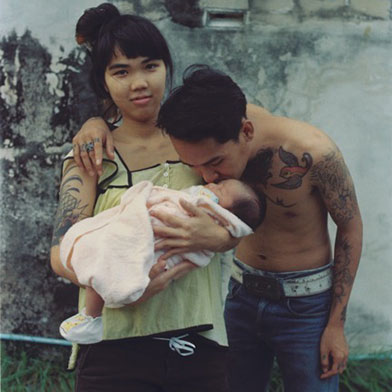
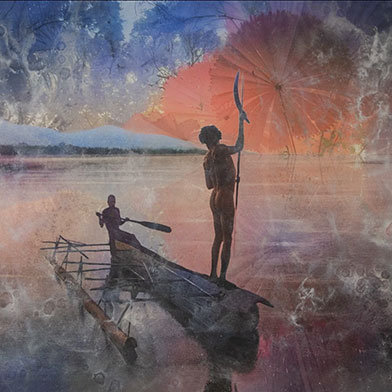
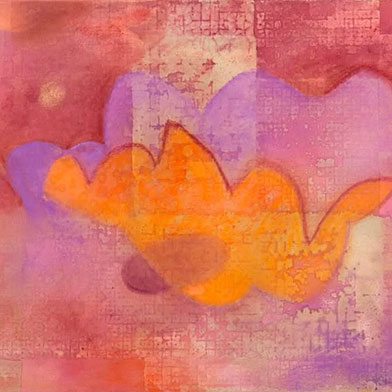
LATITUDE Gallery presents Meanwhile, the mise-en-scène, a six-person exhibition curated by Weifan Mo and Xumeng Zhang. In this group exhibition, the six artists—Eileen Feng, Pan Inkhoo, Athena Parella, Jordan Sears, Da Wang, and Wendy Wei—employ painting as a medium to enact an almost cinematic recounting of urban space. Whether confronting sprawling external vistas or intimate domestic interiors, the artists maintain a deliberate, tension-laden estrangement that transcends the scenarios they depict.
Film theory has long invoked mise-en-scène to capture a fluid and equivocal orientation. In its essence, it entails an engagement with the convergence and organization of the “frame,” spatial architecture, and narrative within a unified field. Stemming from theatrical critique, mise-en-scène is fundamentally “placing on stage.” The camera and the observing gaze it embodies are anchored in a determinate spatial geometry, while the subjects and framing strata drift across the visual field before the lens: crossing in and out, mutually concealing, refracting, or revealing. Mise-en-scène thus signifies a continuous process of transition and emergence, running parallel to the frozen fixity of the viewer’s “now.” Transcending spoken dialogue and plot development, a distinct theatricality articulates itself through this pure spatial choreography, operating on a more subtle and subterranean level.
Inspired by this nuanced perspective in the history of visual culture, the show activates a productive friction between the grammar of film and the stasis of painting. Instead of deploying cinematic tropes as superficial pastiche, the show internalizes their logic to turn the canvas’s absolute immobility into a critical tool. By arresting narrative time, it exposes the fault lines between our physical bodies and the hyper-mediated environments we inhabit. The spatial architecture of the metropolis inevitably assigns the observing “I” to a fixed position; it is precisely the constraints and affective pressure born of this placement that allow these canvases to articulate an uncanny romanticism—one driven by a quasi-cinematic visual impulse.
The exhibition choreographs across two architectural levels, transforming the gallery into a pair of unfolding theaters. Rather than grouping the works into six artist-specific sections, they are fluidly woven across both floors, inviting viewers to continually recalibrate their distance from the images and to interrogate how contemporary urban life is perceived at vastly different scales.
The first unit operates as an open and fluid urban landscape. Streets, journeys, and everyday objects construct a visual field that continually extends beyond the boundaries of the frame. Figures are treated as ontologically inseparable from their surroundings. In this unit, Da Wang places diving, road trips, and surreal elevators between reality and fantasy, allowing familiar cityscapes to remain subtly displaced by chance and ambiguity, as though each painting were a still extracted from an unfinished film. Pan Inkhoo turns to moments that often pass unnoticed: street corners, flower shops, trees, and animals slowly emerge through accumulated layers of mineral pigments. Their soft-focused dissolution mirrors the eerie grain of memory. Wendy Wei superimposes everyday realities with overflowing reverie, turning classrooms, twilight, and television sets into saturated stages for candy-colored emotional intensity.
Meanwhile, Athena Parella’s depiction of an outdoor grassy slope, subtly undermined by parallel shadows that reveal a hidden modern theatrical backdrop, continually blurs the boundary between reality and constructed mise-en-scène. Jordan Sears establishes a mode of viewing reminiscent of the cinematic close-up through vibrant garments, the folds of glossy fabrics, and cropped body fragments. Through deliberate partial disclosures, the materiality of clothing conjures phantom identities well beyond the picture plane. In echoing this cinematic close-up, Eileen Feng’s works manifest as a patterned porcelain plate and a lace-clad back, which seem to weave fragmentary tableaus into the hidden knots and currents of a grandiose banquet.
The second unit gradually shifts the viewer’s attention toward a more enclosed and intimate spatial experience. Grand narratives give way to recessed moods, where color retreats into a more contained register and the narrative voice grows subdued. Parella’s works on paper become a central thread within this section. Beyond conventional figures, staircases, curtains, and doll-like characters carry emotional weight, hovering ambiguously between lived environments and theatrical sets. Feng moves away from richly colored still lifes toward more solitary motifs—including textbooks with handwritten notes, moths, and a folding fan with an egg—that appear loosely detached from realistic context, much akin to fragments archivally preserved from distant memories. Wei’s brushwork weaves an opaque filter, caught in the drift of green algae, the dew-slicked threads of a spider’s web, and the quiet pulsing of jellyfish. Framed by these delicate foregrounds, the distant cityscapes, household sinks, midnight views, and shrimp-handed clocks unfold with the sweet, aching suspension of a lost paradise.
Through their practice, “meanwhile” becomes a sanctuary for introspection. An impulse of visual composition exceeds the mere grasp of quantitative time. Instead, it intimates the kinetics that precede and follow this single frame. The present moment serves as an anchor, brimming with imaginations and desires that bleed far beyond the “now.” This “staging of the present” registers a pervasive grayness within the artists’ canvases—a dreamlike witness to city life, simultaneously yielding to and interrogating the inherent passivity of human existence. Within the dynamic trajectories promised by this theatricality, a misty, liminal, and poetic aura flickers into visibility.
Sign Up & Never Miss a Show