Sign Up & Never Miss a Show
- free weekly opening and closing emails
- free weekly exhibition selection emails
- save and favourite exhibitions
5 Lispenard Street, NY 10013, New York, United States
Open: Tue-Sat 11.30am-6pm
Wed 24 Jun 2026 to Sat 1 Aug 2026
5 Lispenard Street, NY 10013 Inner Landscapes: Liane Chu and Yehong Mao
Tue-Sat 11.30am-6pm
Artists: Yehong Mao - Liane Chu
"There is only one journey at a time: the journey of life, and the path is never straight."
— Søren Kierkegaard
LATITUDE Gallery presents Inner Landscapes, concurrent solo exhibitions by Liane Chu and Yehong Mao. Though working through distinct visual languages—Chu through surreal expressionism and Mao through lyrical abstraction—both artists approach painting as a way of navigating experience. Their works emerge from processes of observation, intuition, memory, and transformation, inviting viewers into spaces where perception remains fluid and meaning unfolds gradually.
Rather than describing the world as it appears, both artists are interested in how it is felt, remembered, and imagined. Through shifting forms, layered atmospheres, and moments of quiet discovery, their paintings reveal the ways inner and outer realities continually shape one another. Painting becomes not a record of experience, but a means of moving through it—a space where uncertainty, wonder, and reflection can coexist.
Working through a language of surreal expressionism, Liane Chu transforms restlessness into reflection. Drawing from personal experience, including her experience living with Tourette's syndrome, as well as travel and continual adaptation, her paintings construct dreamlike worlds where observation, memory, and imagination converge. Cities, coastlines, mountains, forests, and imagined terrains become fluid environments shaped as much by perception as by geography.
Rather than depicting places as they appear, Chu paints them as they are experienced. Forms stretch, overlap, fracture, and reassemble across the canvas, reflecting the shifting relationship between movement, sensation, and memory. Familiar environments become sites of transformation, where multiple moments, viewpoints, and emotional states coexist simultaneously.
Throughout her work, moments of interruption become opportunities for discovery. Influenced by both neurological experience and contemporary digital culture, Chu draws subtle parallels between involuntary movement and the visual language of the glitch. Yet these disruptions are never presented as failures. Instead, they reveal unexpected connections, opening new pathways through which the world—and the self—may be perceived. Through these layered paintings, Chu invites viewers to consider how tranquility might be found not in the absence of movement, but in learning to move with it.
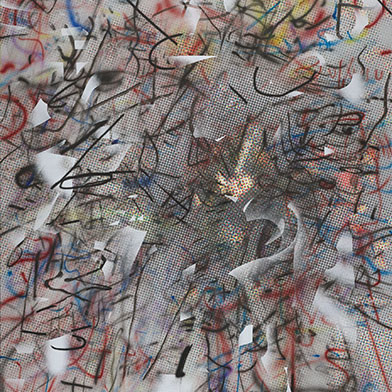
Yehong Mao approaches painting through lyrical abstraction, building richly layered compositions in which color, gesture, and atmosphere become vehicles for contemplation. Working intuitively, she creates kaleidoscopic worlds that unfold as visionary gardens and imagined environments, hovering between abstraction and representation. Forms emerge and dissolve across luminous surfaces, evoking flowers, waterfalls, celestial bodies, and shifting natural phenomena without fully resolving into fixed images.
In Mao's work, lyrical abstraction becomes a language of transformation. Color gathers, disperses, and returns like weather, breath, or flowing water. Guided by sensation rather than narrative, her paintings cultivate a sense of openness where perception remains fluid and meaning unfolds gradually. Through layered rhythms and radiant passages of paint, Mao invites viewers into a meditative space where stillness is never static, but alive with subtle movement and possibility.
Together, Chu and Mao approach painting from different directions yet arrive at a shared concern with transformation. Through surreal expressionism and lyrical abstraction, both artists explore how perception is shaped by movement, attention, and the search for equilibrium. Their works suggest that understanding is rarely fixed, but continually formed through experience.
In an age defined by acceleration and distraction, Inner Landscapes offers an invitation to slow down. The exhibition asks viewers to linger within uncertainty, embrace moments of stillness, and remain open to unexpected ways of seeing. Rather than presenting definitive images of the world, the works propose perception itself as a creative act—one that unfolds through observation, reflection, and the ongoing process of becoming.
Sign Up & Never Miss a Show
