Sign Up & Never Miss a Show
- free weekly opening and closing emails
- free weekly exhibition selection emails
- save and favourite exhibitions
500A West 21st Street, NY 10011, New York, United States
Open: Tue-Sat 10am-6pm
Thu 7 May 2026 to Sat 27 Jun 2026
500A West 21st Street, NY 10011 Ruby Rumié: How are the Children?
Tue-Sat 10am-6pm
Artist: Ruby Rumié
Ruby Rumié’s new exhibition offers an incisive view of childhood as a measure of the world. The question in the title is not a greeting, but an ethical standard: it is through them that the state of the world is revealed. Childhood, a fragile and deeply political terrain, is traversed by a silent contemporary violence. In the mud of the volcano—where the body sheds and resists—everything, without consolation or metaphor, returns us to the same question: how are the children?
This is not a greeting or a polite formula. It is a question that, in Maasai tradition, condenses the state of an entire community: How are the children? In them, one measures collective health, care, time, nourishment, and the future.
From this question, the artist Ruby Rumie presents her new exhibition—a project that places childhood at the center as a political, symbolic, and ethical territory.
The work does not arise directly from African tradition, but from an absence: an old newspaper clipping recording the disappearance of several children on a distant island. This trace, almost invisible among family albums, was enough to trigger an artistic inquiry that does not seek to explain events, but to sustain a persistent unease.
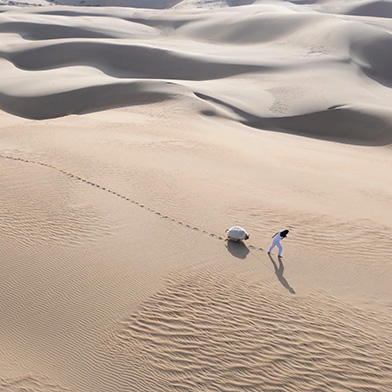
Within the narrative that structures the project, eleven children set out on a journey. They flee normalized violence, the acceleration of the contemporary world, the pressure to conform and perform. Their path leads them through a volcano—an image that becomes a metaphor for passage, rupture, and transformation.
Based in Cartagena, the artist situates the action at the Totumo Mud Volcano, a crater of mud charged with deep symbolic and ancestral meaning. There, mud becomes the central material of the project: at once organic and mineral, healing and unsettling.
To submerge oneself in the volcano is to confront a primal fear—the sensation of sinking—yet the unexpected occurs: the body floats. In that suspended state, mud ceases to be dirt and becomes a surface of revelation. It covers without concealing. It interrupts without embellishing. It strips the body of social labels—age, gender, origin—and returns it to its most elemental condition: matter.
In a context saturated with images and inhuman standards of beauty, covering oneself in mud becomes an act of quiet resistance. The body ceases to be spectacle and recovers its symbolic density. In the exhibition, the children surround the volcano without dramatization or artifice. They remain. Each holds a red ribbon descending from the summit into their hands. The volcano ceases to be a threat and becomes a matrix, a shared origin.
Rather than offering definitive answers, the work resides in listening, in the company of a reality that confronts us. The project proposes no certainties; instead, it returns the question to the viewer as an ethical measure impossible to evade:
How are the children?
¿How are the children?
[1] Kasserian Ingera is an expression from the masái land that signifies: ¿How Are the Children? a form of asking about the health and wellbeing of a whole community through its most vulnerable.
Sign Up & Never Miss a Show