Sign Up & Never Miss a Show
- free weekly opening and closing emails
- free weekly exhibition selection emails
- save and favourite exhibitions
44 rue Quincampoix, 75004, Paris, France
Open: Tue-Sat 11am-7pm
Artist: Mathieu Cherkit
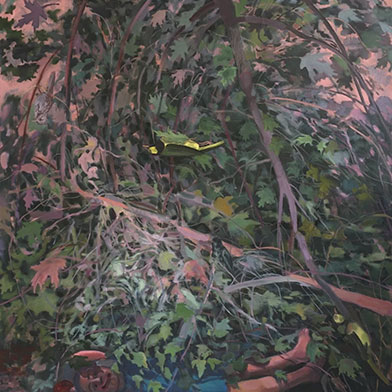
For his first exhibition at Semiose, Mathieu Cherkit presents fifteen paintings that share a unity of place, all originating in or around his home-studio. This apparent coherence is above all a pretext for a pictorial investigation into the question of viewpoints. The house is merely a context, a point of departure, and its objects elements of composition. Each painting engages with the act of looking—where the gaze settles, and how painting reconstructs it. The artist aggregates, combines, articulates and merges the movements of the body with the trajectory of the eyes, turning familiar, everyday space into a site of continually renewed visual experiences.
This plurality of viewpoints stems first of all from the temporality of the paintings’ execution. Beginning in the middle of the day, they are painted according to a precise method: each section is worked on at the same time of day in order to benefit from consistent light from one day to the next. Thus, in Sleepy Solo (2026, as are all the works in this exhibition), the flowers at the foot of the bed were painted at a set time, distinct from that of the bedspread, which, despite being close by, was painted later in the day. Each of Mathieu Cherkit’s paintings has its own internal chronology, repeated daily until the work is complete. The diptych Tendrement makes even more tangible this progression of gestures over the course of the day and as the work advances: its left-hand section, in daylight, gradually spills into the right-hand panel, which was painted later, in the dimness of evening.
Dispensing with photography, Mathieu Cherkit works back and forth between memory, his sketches and observations made on site. The sketch allows him to establish the overall structure, planes and colours in broad strokes, while some works can be painted directly in front of the subject. For Yelo Flow, for instance, the easel was taken out of the studio and positioned facing the staircase. There was no need for a preparatory sketch, given how frequently this motif recurs throughout his work. For Mathieu Cherkit, the rightness of the viewpoint matters more than its exact replication. For this reason, when transferring a subject from sketchbook to canvas, the artist does not use a grid. None of his paintings bear a direct proportional relationship to reality: each one seeks instead to remain faithful to the artist’s perception and impressions.
Although photography does not form part of his research process, the artist does incorporate viewpoints close to those of a camera and its movements. In Orval, the overhead view of the stream accentuates the distortion of the branches as they enter the muddy water. Octogone is probably the work in which the cinematic gaze is most active. The tight framing lends prominence to the geometric forms: the outline of the sink that gives the work its title encloses the circles of the plate and the drain; in the upper part of the painting, the cylindrical forms of the glass and saucepan echo and extend them. The composition of the image seems to follow the movement of a camera, beginning with an overhead view of the sink before straightening up and elongating the circles into cylinders. The image also appears to be constructed through tight framing around one section of the sink, with the presence of a second basin discernible on the right. Elements beyond the frame recur throughout Mathieu Cherkit’s work, particularly in the small-scale paintings made outdoors. Ribes Rubrum, Papaver Rhoeas and Alcea Rosea extract plants from their surroundings, framing them in such a way as to emphasize their structure and bring out the red and pink tones.
Throughout, perspective is askew—or rather, it is multiple. In Matière Noire, a cooker, with a saucepan of eggs resting on it, is seen simultaneously from above, from the side and at an angle. Every element¬—burner, grate, knob—is painted from the most interesting angle from which to show it, resulting in a combination of viewpoints that recalls the foundations of Cubism. These hybrid perspectives within a single painting can also be understood as the meeting of different eye levels: that of the adult painter and that of a child who might catch sight of an object while standing on tiptoe. In another painting, La Toilette, the vanishing point appears lower, as if the painter had lowered the easel. Mathieu Cherkit’s works thus evoke the peculiar experience of being a child, moving through and inhabiting spaces that seem disproportionately high and disproportionately large, climbing onto every piece of furniture, finding every object a source of curiosity and discovering that it can be diverted from its original function.
Play, indeed, runs through all of Mathieu Cherkit’s work. There are games reproduced in paint, such as the Pokémon card next to a composition of loaves and a baguette (Du Pain et Du Jaune), or the game console carefully held in both hands in Côme, but also childlike motifs. Hidden within the painting, a flying saucer hovers over the sink in Octogone, a figure merges into a knee in Côme, a pair of cherries is camouflaged in Papaver Rhoeas, and a fish in Forteresse. These drawings are worked into the thickness of the oil paint as the ground is prepared. They are then covered over as the painting is completed, concealed beneath its washes, prompting viewers to wonder at the image buried within. The sense of play extends even to the pile-up of red chairs in Red Glitch, whose many planes present pictorial challenges. The aim is never to paint like a child, but to allow the perspectives of the child and the adult to coexist within the painting.
Each of Mathieu Cherkit’s paintings reveals a close attention to framing. In his practice, which plays with the thickness of the paint and spills beyond the sharp edges of the stretcher, one senses how central the question of the frame is. Working in this way also raises questions of the object and the fragment, and thus of the relationship between the painted image and materiality—that of the things represented, or of painting itself. The thickness of the paint, which allows for revisions, complicates the rendering of detail, since the grain of the canvas has disappeared beneath successive layers. Positioned at the edge of the canvas, the real bee and its painted double in Forteresse appear all the more delicate.
It has been written that Mathieu Cherkit’s work is figurative, that, at the same time, it borrows from abstraction, and that, ultimately, it depicts his domestic environment. These observations, each of which offers a way of approaching part of his pictorial production, focus on what is represented, whereas it is the paintings as a whole that deserve to be considered. Perhaps it is by attending to their dimensions that we can best approach the investigation pursued by Mathieu Cherkit: each format is chosen because it corresponds to the scale of one of the objects represented. What is at stake is less the realism of the gaze than the singular relationship between the format of the object and the format of its representation. From this practice, in which the canvas is scaled to the object, itself distorted by the successive viewpoints brought to bear upon it, emerges a sense of strangeness. With their interwoven planes and receding contours, as though the paint itself were running, these everyday scenes place the viewer in a hallucinatory state, scrutinized in turn by the yellow eyes of Chat Noir.
Camille Richert
Sign Up & Never Miss a Show