5036 W Pico Blvd, CA 90019, Los Angeles, United States
Open: Tue-Sat 10am-6pm
Sat 6 Jun 2026 to Sat 11 Jul 2026
5036 W Pico Blvd, CA 90019 Gabriel Rico: Gabrielinos (I Am You And What I See Is Me)
Tue-Sat 10am-6pm
Artist: Gabriel Rico
Gabriel Rico: Gabrielinos (I Am You And What I See Is Me)
6-8pm
Perrotin Los Angeles, 5036 W Pico Blvd, CA 90019
Perrotin presents Gabrielinos (I Am You And What I See Is Me), Gabriel Rico’s first solo exhibition in Los Angeles. Through textile, assemblage, and sculpture, Rico explores the connections between humanity and nature, and our methods of communication, asking viewers to reflect on the lifeforms that surround us.
Gabriel Rico’s practice is grounded in traditional Mexican artistry, unique to the state of Jalisco, where he was born and continues to live today. The mediums he works with are not only rooted in artisanal techniques of Jalisco, but also of the Wixárika (or Huichol), an indigenous group who originated from and still reside in Jalisco, specifically the village of San Andrés Cohamiata (Tateikie). After years of pilgrimages with the Wixárika, artisans of the community offered to collaborate with Rico to employ the technique of Niérika, where yarn is meticulously arranged, thread by thread, on beeswax covered wood, revealing an intricate design. Traditionally used to document spiritual visions and dreams, Rico adapts this process to translate his own artistic concepts, ultimately leading to his series Decorative permutations and The open sets.
The works in these series explore methods of communication across time. A medley of branches bearing citrus fruits display symbols ranging from ancient cave paintings to modern day emojis, reminding us that so much can be understood without words at all. This silent language also exists in nature, where plants communicate through chemical, hormonal and electrical signals transmitted through roots, branches and leaves. Foliage has been a common motif by Rico, but for the first time in an exhibition, he translates this imagery into a tapestry, a medium he has not worked with in almost two decades.
In a new body of work titled Molar Pines M1, neon vine-shaped fixtures and glass bone sculptures evoke the similarities between humans and nature, and our dependency on the environment. The beauty of this sculpture lies in its materiality: the manipulation of glass blowing contorts the sculpture to appear as though it is metal, which reflects green light from the neon fixtures. While aesthetically pleasing, the mural also underscores humanity’s reliance on nature. Bright, contrasting colors also occur naturally in certain flowers, insects, and animals, as a method of communication, often serving as signals related to pollination, protection, or warning in aposematic species.
Rico’s central sculpture, Pink Pumpkin from the series - This Bitter Earth, highlights nature’s reclamation of space and resilience to human intervention. Inspired by a walk through his neighborhood in Guadalajara, the artist renders cucurbita vegetables growing through a fence, adorned with copper and brass leaves. While the continuation of species depends on movement, growth, and adaptation—from birds flying south each winter to human migration around the world—humans continue to build physical and ideological borders. This Bitter Earth questions the necessity and permanence of the boundaries that humanity constructs.
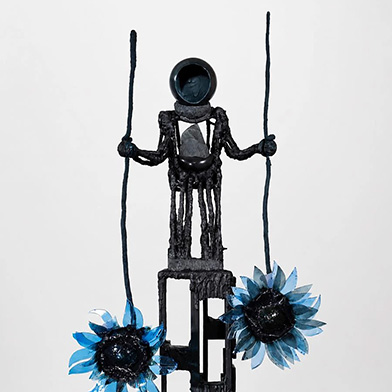
For the last several years, Rico has created artworks in dialogue between mathematical equations and visual compositions to convey the shared and disparate aspects of humanity. In his sculptural assemblage series titled Made to the measure of the world, composed mostly of found objects and glass bones, Rico suggests that although we experience life individually, tangible similarities connect all species. In emphasizing the interconnectedness of all forms of life, Rico evokes a cosmovision held by both the Wixárika and the Gabrielino-Tongva, the indigenous people of Los Angeles. While the title of the exhibition partially stems from the fact that the artworks are derived from Gabriel–hence “gabrielino”–it was important to him to honor the people of Los Angeles, and acknowledge the similarities between these Uto-Aztecan nations.
Ultimately, Gabrielinos (I Am You And What I See Is Me) connects the history of Los Angeles—its land, people, and culture—to the artist’s own homeland and beyond. When describing his reverence for the city, Rico says, “visiting Los Angeles is like visiting family, like going to your cousin’s house...there’s a shared language, food, and way of life, that although it may not be your own home it feels like family.”
Sign Up & Never Miss a Show