Sign Up & Never Miss a Show
- free weekly opening and closing emails
- free weekly exhibition selection emails
- save and favourite exhibitions
273 Church Street, NY 10013, New York, United States
Open: Tue-Sun 10am-6pm
Friedrichs Pontone presents Frameworks, a group exhibition featuring works by Julia Rommel, Hwang Seontae, Andrea Joyce Heimer, Imi Knoebel, Richard Serra, Walter Price, Bernard Piffaretti, Dagoberto Rodriguez, Jonathan Chapline, Sheree Hovsepian, and Ellen Lesperance.
The pictorial language of geometric abstraction is based on simple geometric shapes which, when combined, create a non-objective form that represents an artist’s attention to detail, and mastery of mathematical composition. Form is dictated by the artist, who decides their applications of lines and shapes to create their work. The methodology of applying precision to line and form when artmaking evokes a reality built on minimalist principles. Within this framework, contemporary artists who create non-representational art rely on geometric line and form to execute constructions and deconstructions of various images. By using reductive and abstract elements, artists can portray foundational emotions and experiences without overt representation.
In context with the use of line and form, Friedrichs Pontone presents Frameworks, a group exhibition featuring works by Julia Rommel, Rado Kirov, Hwang Seontae, Andrea Joyce Heimer, Imi Knoebel, Richard Serra, Walter Price, Bernard Piffaretti, Dagoberto Rodriguez, Jonathan Chapline, Sheree Hovsepian, and Ellen Lesperance. The exhibition reveals how these contemporary artists reduce figurative forms, only embracing meticulous design and line work to create non-objective works, communicating an essence that reaches beyond the surface of the canvas.
The works shown in this exhibition exist within and against their own frameworks. Each artist confronts the fundamental question of how visual complexity can be distilled into refined simplicity, where deliberate linework and compositional precision become a language of their own, communicating what representation alone cannot.
Julia Rommel paints through a laborious process including cutting and sanding her canvases, and then adding numerous layers of paint. Her method stresses the canvas surfaces with physical manipulation, allowing for imperfections deliberately made with precision.
Rado Kirov’s sculpture consists of wall-mounted reliefs and free-standing sculptures, all fabricated from stainless steel with highly polished surfaces. Some are geometric, some explicitly furniture-like, others are beads and droplets of formless matter; still more are glistening, reflective panels expressive of flowing landscapes. A new development are reliefs that reference the sensuous surfaces of the human body. The various pieces are subtly shaped by hand to yield complex, undulating forms from hard metal.
Hwang Seontae constructs light boxes using tempered glass with an LED backlight creating domestic interiors that emphasize the beauty and light of the natural world. The space within his white-out interiors is heavily contrasted by the vibrancy of nature, sparking a degree of dystopia as the seemingly empty, but clean, rooms are given life by the sun and Seontae’s mastery over light.
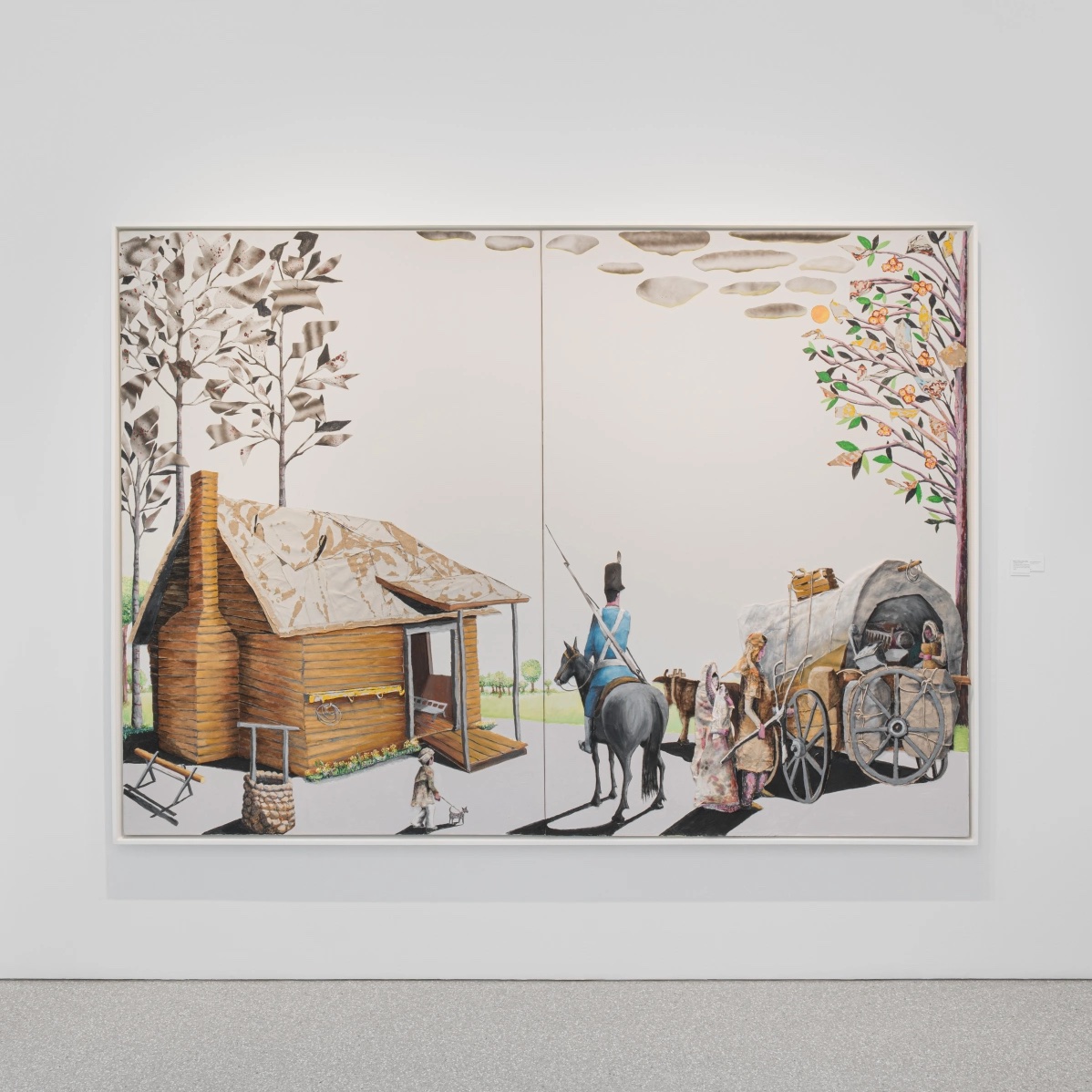
Andrea Joyce Heimer’s painting and drawing practice investigates the subject of loneliness, largely informed by autobiographical stories such as her own adoption, in order to examine how humans experience feeling alone and its connection to how and why we make art. Her works use simplified shapes and brush strokes to create figurative beings engaging in a relational matter in regards to the narrative titles of her works.
Imi Knoebel’s minimalist hybrids of painting and sculpture explore relationships between color and structure. Knoebel’s nonrepresentational works innovate on the modernist ideas and styles of Joseph Beuys, Kasimir Malevich, and the Bauhaus; the artist is interested in seriality, spare geometries, reductive color, and the use of industrial materials.
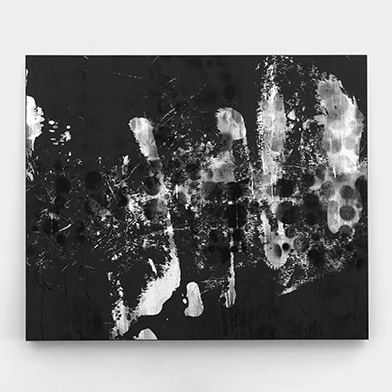
Richard Serra is renowned for his monumental site-specific artworks that alter viewers’ perceptions of space and proposition. He also reflects similar sentiments with his fierce black-and-white abstract drawings with oil sticks on paper. These large scale, two-dimensional drawings represent Serra’s devotion to the grandiose and the minimal, juxtaposing these opposites through the manipulation of paper by creating these large, black rectangles that resembled the materials he would use to build his sculptures.
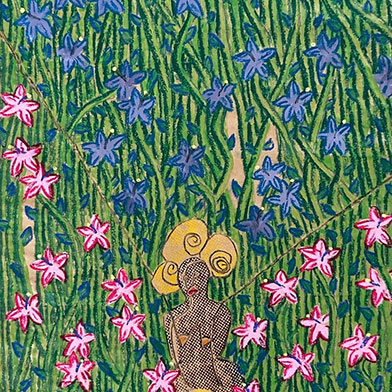
Walter Price is known for his richly vibrant paintings and drawings, which bypass strict allegiances to representational or abstract modes. In his work, the artist sensitively employs an idiom of motifs that traverse the real world and the dream world, memory and collective history.
Bernard Piffaretti analyzes the repetition of forms within painting. In his own work, he has coined the “Piffaretti system,” where he repeats the same shapes, colors, and positions onto two separate canvases and then later combines them. The combination of the array of shapes and colors converge where the viewer becomes unable to discern that the paintings were separate at one time or another.
Dagoberto Rodriguez believes watercolor is a critical part of his creative process, as a way to collaborate, record and revise his ideas. Many of his works reflect his mastery over the medium, creating sharp and deep shapes that allow for metaphorical and symbolic “poetic acts.” These acts affirm his engagement with politics through art, understanding that his works, while orchestrated with fine detail, carry a meaning that exceeds the form.
Jonathan Chapline incorporates analog and digital processes into his painting practice as he blurs the division between the real world and the virtual realm. The artist uses 3D-imaging software to recreate his own photographs and old magazine pictures, then replicates the images on canvas with acrylic and vinyl paints. His uncanny compositions, which resemble architectural renderings, feature blocky bodies and midcentury interiors shaded with bold blues, reds, purples, and pinks.
Sheree Hovsepian works with film-based cameras, light-sensitive paper, various objects, and her own body to produce cerebral and sensual photographs in which she deconstructs her medium. She produces all her photographs in the studio and darkroom using traditional printing techniques. Confounding and subtle, her work reflects her deep knowledge of the history and theory of photography.
Ellen Lesperance centers her work around the female body engaged in acts of protest. Her works on paper include meticulous gouache paintings and most recently lithographs made from multiple layers. Her gridded forms depict what she describes as “protest sweaters”—made and worn by feminist activists. She renders the garments with exacting detail in the knitters’ language of Symbolcraft, making it possible for knitters to decode and re-create the garments
Sign Up & Never Miss a Show