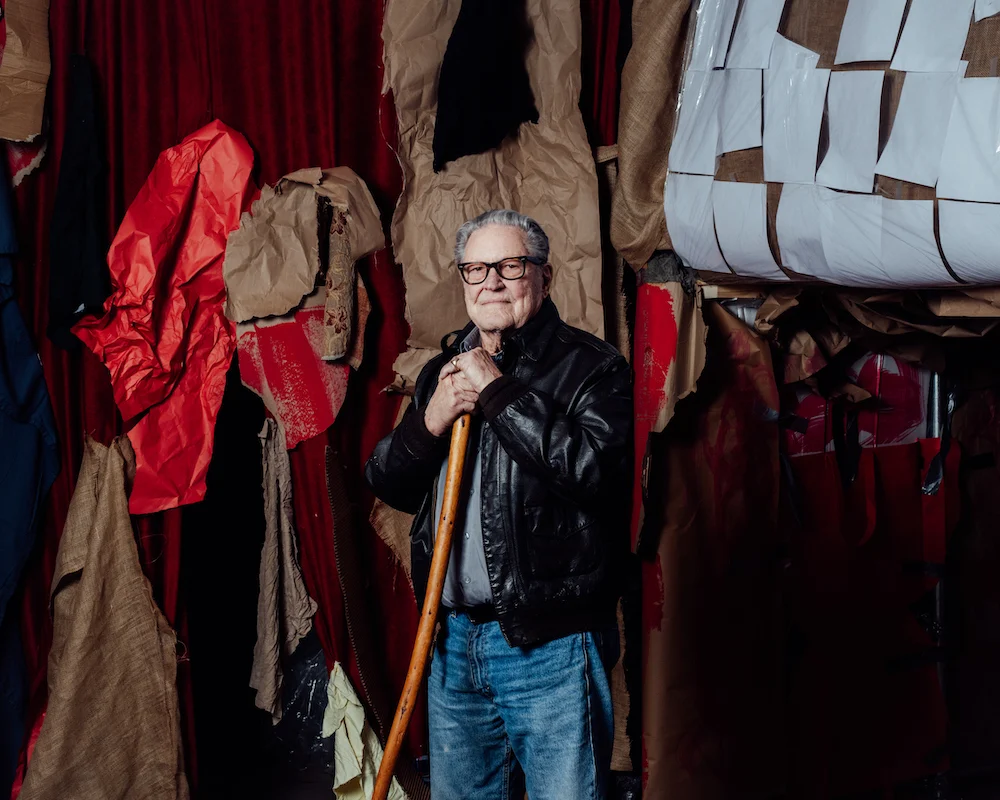
Robert Whitman passed away on January 19 at the age of 88.
A pioneer of performance and multimedia installation work, Whitman devoted his career to extending the boundaries of art as we know it. He was a seminal figure in the performances called Happenings - a hybrid art form spanning installation, performance, and other mediums - presented in New York in the early 1960s by a group of artists that also included Claes Oldenburg, Allan Kaprow, Jim Dine, and Red Grooms, and he was also at the vanguard of scientifically and technologically engaged art making during this period, having co-founded, with artist Robert Rauschenberg, the Experiments in Art and Technology (E.A.T.), a collective that supported creative partnerships between artists and engineers, in 1967.
“It would be difficult to overestimate Bob Whitman’s importance in the artistic milieu of 1960s New York. Bob was a true pioneer. His Happenings blurred the line between dreaming and waking life. Somehow, he made the fantastic real. His many amazing collaborations in performance were unforgettable, none more so than the 9 Evenings he did with Rauschenberg. From the beginning, I was deeply intrigued by his vision, and I remained astounded by his brilliance over the course of seven decades of our friendship. Working together was one of the great privileges of my life.” - Arne Glimcher, Pace
Also in 1967, he had his first solo exhibition with Pace at its West 57th Street gallery in New York. Titled Robert Whitman: Dark, the show featured two laser installations that Whitman created in collaboration with Eric Rawson, an engineer with Bell Telephone Laboratories: Wavy Red Line, in which a spinning red laser produced a fixed red line, growing and shrinking at specific intervals across four walls, and Solid Red Line, in which a laser drew itself around the four walls and, when it met its end, erased itself.
“The thing about theater that most interests me is that it takes time. Time for me is something material. I like to use it that way. It can be used in the same way as paint or plaster or any other material. It can describe other natural events.” - Robert Whitman
photo: George Etheredge for The New York Times