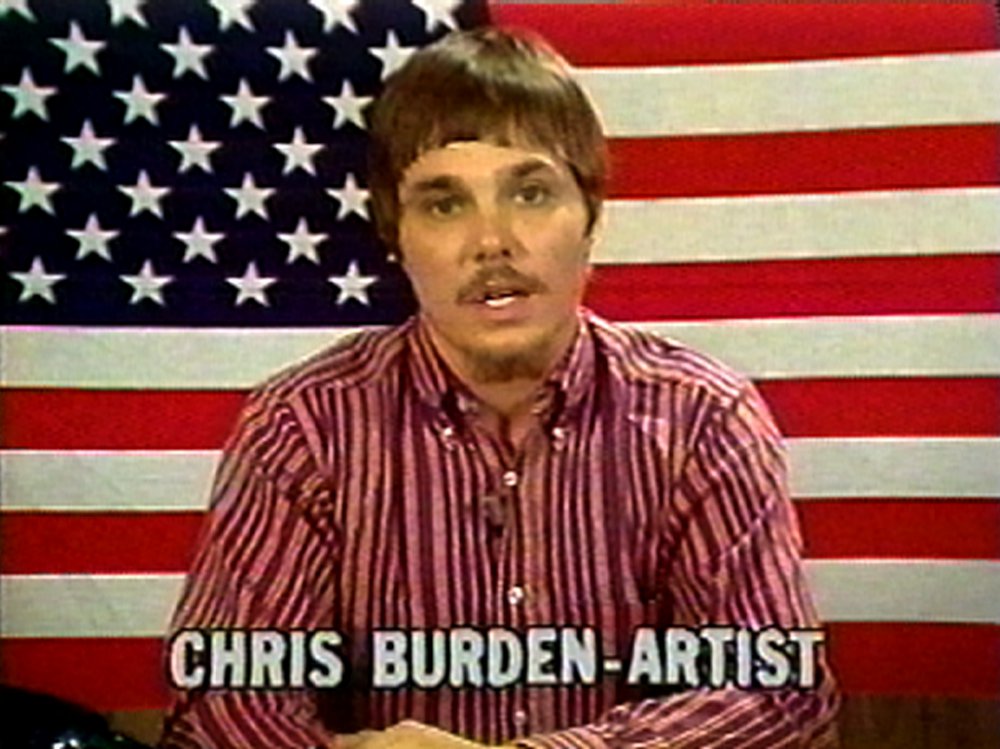
Chris Burden, The TV Commercials 1973-1977 © Chris Burden/ARS/EAI
One of Hans Ulrich Obrist’s favourite questions when interviewing artists is to ask about any “unrealized projects” they may have - it is a great way of allowing the artist to look out to the whole realm of possibilities without any practicalities intruding into the creative process. Unrealized work has also been an enduring fascination when it comes to artists who are no longer with us - what could they have done, what would they have done if they could, where would they have taken us?
The American artist Chris Burden was the first person to be represented by Larry Gagosian. Burden was known, especially in his early work, for pieces that involved direct physical danger and highly political, boundary-pushing performances. As he moved more into installations he retained both of these facets and continued to produce work that could be as controversial as it was influential.
 The gallery has published a book “Poetic Practical: The Unrealized Work of Chris Burden” which details over sixty of his uncompleted projects, stretching across many disciplines since, as Burden said himself “much of my art has dealt with energy, systems of transportation, architecture, and power”. For an artist whose realised works included him being shot (literally, with a rifle), in Shoot (1971), and engineering a flying steamroller, The Flying Steamroller (1996), the idea of where his imagination could have taken us is especially beguiling - and the book includes facsimiles from Burden’s notebooks alongside many of his reference photographs to take us on highly detailed proposals from an artist who would never let practical considerations impinge on his creative drive.

The book will be the subject of a discussion at the gallery’s bookshop in Burlington Arcade, London, on April 4 at 7pm, where Vicky Richardson, head of architecture at the Royal Academy of Arts and Yayoi Shionoiri, executive director of the Burden estate, will discuss how Burden challenged the lines between art and architecture as well as his continuing influence on the wider art world.
The exhibition Chris Burden: Cross Communication is at the gallery’s Park & 75 space in New York until April 29.
Chris Burden was an American artist who gained international recognition for his thought-provoking and boundary-pushing performances and installations. Born in Boston in 1946, Burden studied arts, physics and architecture at Pomona College in California and went on to do his MFA at the University of California.
Burden’s early work was characterized by performances which often involved putting his body in danger, exploring the limits of physical endurance and the relationship between the performer and the audience. One of his most (in)famous pieces from the time was “Shoot” (1971) where Burden’s friend shot him in the arm from a distance of about fifteen feet with a .22 caliber rifle.
In the years that followed, Burden continued to push the boundaries of performance art with works such as “Trans-fixed” (1974), where he was crucified by being nailed to the back of a Volkswagen Beetle, and “Through the Night Softly” (1973) which he described as “holding my hands behind my back, I crawled through 50 feet of broken glass. There were very few spectators, most of them passersby”.
In the late 1970s and early 1980s, Burden’s focus shifted to installations, which often incorporated large-scale machinery and industrial materials, such as “The Big Wheel” (1979) where a large, circular platform is spun at high speed, driven by a motorcycle.
Burden’s work often engaged with larger social and political issues, and many of his performances and installations were explicitly political in nature. He continued to create challenging and provocative works throughout his career up to his death in 2015, and remains a highly respected figure in the art world.