The exhibition was prompted by a change of address. Many of the works were made for MacMillan’s own London house, a home loosely inspired by the Bloomsbury Group’s Charleston. In her house art was something to live with and alongside, rather than merely to decorate or fill a space. When The World of Interiors featured the house in 2020, it described a “woman of letters” whose words, in her own distinctive script, wound across walls, lampshades and bookcases. MacMillan came to think of each room “like a chapter in a book”. If the house was a book, this exhibition, which brings together works from every room now that it is no longer lived in, is its foreword, written after the fact.
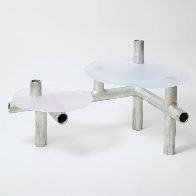
Alongside these are works made with similarly finite destinations in mind: museum exhibitions and installations that have since been taken down. Shown together here for the first time, they form a mini-retrospective of the many media the artist works in, from felt and crochet to metalwork, drawing, words, perfume and honey.
Foreword asks what happens to an artwork when it leaves the place it was made for. A work has several homes: it first exists within the artist, then in the studio where it takes form, and finally in the space where it is shown. When is it finished, and is it ever? Its meaning shifts with its surroundings and with the life lived around it: a line of felt poetry passed every day on a staircase becomes something else on a gallery wall. For the length of the exhibition the gallery becomes a temporary home, and the artist moves in with her work. Seen side by side for the first time, the works fall into new conversations, revealing connections that even the artist may not have seen before.
As a multimedia and conceptual artist, MacMillan is defined less by any one material or aesthetic than by the ideas she returns to: language, optimism and connection. Ideas are her artistic vocabulary, so it is fitting that the most recognisable thread running through her practice is her own script: tall, narrow letters, cut in bright colours, that are unmistakably hers.
The show also marks another change: Kate Daudy is now Kate MacMillan. For an artist, a name is inextricably bound up with the work itself. It is the signature on the work, the name on the spine on the bookshelf and the line in the auction record, and it helps to vouch for what a work is and what it is worth, both conceptually and materially. Artists have rarely adopted stage names, but some have chosen to rename themselves, from Gluck and Claude Cahun to Alighiero e Boetti and Marcel Duchamp’s alter ego Rrose Sélavy. Foreword is the first exhibition under the artist’s new name. Yet as her script already speaks in her voice, the name beside it matters less than it might: the work is recognisably hers, however it is signed.
Kate MacMillan (b. 1970) lives and works in London, UK. She previously exhibited as Kate Daudy.
MacMillan is a British conceptual artist best known for her public interventions and large-scale sculpture. Her imagination extends across many art forms, from felt, textile and crochet to metalwork, sound, scent and film. She speaks several languages, and words are often at the heart of her work. Her practice is driven by personal engagement, an innovative use of new materials and technologies, and a long-standing commitment to the environment. She has enduring collaborations with scientists and thinkers, most notably Nobel Prize-winning physicist Kostya Novoselov, with whom she has developed the ongoing art and science project Everything Is Connected.
In 2024–25 MacMillan was an Abigail R. Cohen Fellow at Columbia University’s Institute for Ideas and Imagination, which invites artists, writers and composers from around the world to pursue their own projects in a year-long dialogue with one another. Her fellowship project was Telling the Bees.
Among her best-known works is Am I My Brother’s Keeper?, an immersive installation about home and identity made with UNHCR and ONUART. Since 2016 it has toured to venues including St Paul’s Cathedral, the Saatchi Gallery and Manchester Art Gallery, and it is now on the national curriculum in Spain. Everything Is Connected has been shown at Yorkshire Sculpture Park, the National Graphene Institute in Manchester and NUS Museum in Singapore.
In 2025 the Sorbonne in Paris held a retrospective of her work, If Not Now, When?, with a catalogue essay by James Fox. Other recent projects include Superbloom with Lyndsey Ingram (2024), public commissions for Palermo Cathedral and Glastonbury Festival, and a permanent Honey Window for Columbia Global Centers in Paris. Her books include I Am Easy to Find (2019) and I Knew You Would Come Back to Me (2021), with texts by Marina Warner.
all images © the gallery and the artist(s)