Like a river, time flows within each moment’s stillness, resounding the indelibly personal perceptions that distinguish the Self within the ecologies that we inhabit. So, we listen inwardly, while navigating what we sense, housed in the transient textures of time’s touch. Traces linger, reformulating the past into the present.
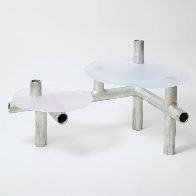
Salvaged from excavations, sculptor Amanda Cornish appropriates artefacts, marked traces of urban and environmental strata. Recast, these markings resound memories, histories personal, collective and ecological, demarcating time's touch, Take 2024’s Murmurings From No-Man’s Land’s, sculpturally reconfigured Thame’s riverbed remnants - rusted steel casting tubes. Repurposed from soil sampling during the Hammersmith Bridge’s restoration, the tubes elicit six channel field recordings and river sounds. Alluvium, 2026, embodies movement’s stasis and time’s invisible lapsing, as moulded multi-tonal earth balls, dug from riverbeds, cascade tide-like across the gallery floor. Archivally, tonal variances and debris reflect the Thame’s flow down river, across England, as well as changes in London’s socio-economic fabric over time.
In Spines, 2025, worn sapling-like branches become plastered and painted into petrified repose. Lined up, they allude to the human body, in nuanced variance. Their contained hollow spaces signify the timeless stillness held silently, within our cherished Selves. In a recent work, Escapement, 2026, clock weights echo the impending obsolescence, yet beauty, of grandfather clocks’ sonic, temporal demarcation, in our everyday lives. The pendulum swings, the earth turns.
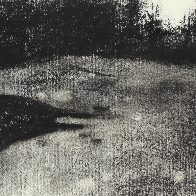
Like a movement in a musical score, Jamila Al Adwani’s film, I’ve never touched the Thames, 2026, will accompany Cornish’s Thames series. Retracing Cornish’s Thames walking route, she captures her own vision and time’s textures, using historic home-film cameras. Thus, she reinterprets and recontextualizes time, technologies’ filmic passing, and Cornish’s Thames passage. A global drift speaks to universal human experience and their ecologies, within the intimacy of personal experience’s sensory perceptions.
All works witness time’s passing, to evoke haptic sensory awakening and multilayered associative references. Phenomena’s symbolic allusions reify experiential stillness. How permanence and impermanence shape our existence becomes manifested. Reframed, reconceived artifacts exhume fluid memories. So, life’s incremental traces flow through our consciousness, as unconscious strata in life’s elusive schema.
Housed in the urban formerly domestic setting of GPS Gallery, in a Soho Housing Association townhouse, the exhibition speaks to how urban architectures, and their environmental counterparts overlap, historically and experientially, in the everyday. So, we uncover underlying infrastructures and entanglements, to experience a continuum of archaeological-like strata in our personal and collective lives and surroundings – existence in this place and all time. This exhibition is the third exhibition by Fascicle Contemporary on the theme of Fluid Architectures, 2026, curated by Beverley Harrison.
Amanda Cornish is a London-based multidisciplinary artist whose practice begins with the shared vulnerability of human and ecological systems. She explores how both endure cycles of use, degradation and renewal.
She aims to create encounters that reflect ecological cycles and invite us to reimagine renewal as a shared ongoing process. Her site-responsive and process-driven works utilize field recording, foraged soil, wood, and domestic items such as clothing and soap, as well as text and discarded industrial materials.
Her work mediates objecthood and perception, where sculptural surfaces become records of contact, memory and time, leaving traces that coproduce meaning. These marks reveal how materials act as living archives, holding historical cultures as well as ecological and personal histories within their layers, creating spaces for stillness, reflection, and renewed attention. This spatial stillness, fragility yet resilience and agency, becomes embedded in matter, as experiential poetry.
Jamila Al Adwani is a British Kuwaiti director with a background in Art Direction, known for her eclectic visual language and layered, reference-rich style.
Jamila began her career as a Creative Researcher, conducting deep dives into visual research, crafting treatments across commercials and music videos. As a Director’s Assistant, she gained valuable on-set experience alongside award-winning directors. Now directing in her own right, Jamila blends her love of subcultures, offbeat narratives, and the slightly surreal. Her practice is rooted in research that moves beyond sourcing references to dynamic visual histories of the unexpected.
all images © the gallery and the artist(s)