138 Tenth Avenue, NY 10011, New York, United States
Open: Tue-Sat 10am-6pm
Artist: Pam Glick
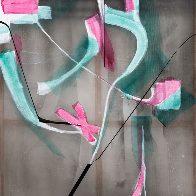
Nicola Vassell presents PG-13, Pam Glick’s debut solo exhibition with the gallery. The exhibition showcases the first body of work Glick has produced since returning to live in New York City after a 30-year hiatus. Reflecting her recent forays into isolating stacks of color, these bold paintings engage with earlier works, in which vibrant swirling forms reveal an ongoing interest in the direction of movement and color across the picture plane.
Glick first emerged as a rising star of the raucous early 1980s New York art world. Working from a studio on East 7th Street and 2nd Avenue, she was at the epicenter of a boisterous community of avant-garde artists, exhibiting her work alongside George Condo and Jean Michel Basquiat. Glick’s first dealer, Jamie Wolff, championed other daring and influential voices, including Robert Gober and Christopher Wool, among many others.
Leaving New York for Vermont and then her native Buffalo, she continued to push the boundaries of her work, allowing it to deepen and mature. Endurance, sacrifice, and rigor—the same qualities that made her a successful teen athlete—became essential to sustaining her artistic practice. Now, re-engaging with New York and the energy that initially drove her practice, Glick channels the city’s pulse into a new body of paintings.
Animated by a language of her own, Glick’s compositions are organized through numerous horizontal and vertical delineations, suggesting the regularity of a grid. Upon closer observation however, one notices the continuous disruption by curved, looping, and free gestural marks. White lines form an intricate web across a predominant color, overlap and intersect, break through, and, in doing so, create a complex network of positive and negative spaces. The resulting tension between geometric organization and spontaneous mark-making gives the surface a sense of dynamism and visual vibrancy.
Although her work draws on key elements of Minimalism, including grids and monochromes, it resists the exactitude and austerity often associated with the movement. Instead, luminous fields meet gestural whirls in a fluid interplay, revealing the many layers that bring each painting to completion. Rooted in the body rather than the mind, Glick’s work is driven by vigorous movement. The physical exchange between artist and canvas informs the muscularity of her aesthetic and the athletic rhythm that permeates the work. Her paintings evoke abstracted memories of the experience of nature, and convey an immediate emotional response: Joy.
Sign Up & Never Miss a Show