24 Grafton Street, W1S 4EZ, London, United Kingdom
Open: Tue-Sat 10am-6pm
Artists: Al Taylor - Albert Oehlen - Andreas Eriksson - Georg Baselitz - Julie Mehretu - Mamma Andersson - Martin Kippenberger - Per Kirkeby - Rosemarie Trockel - Tacita Dean - Huma Bhabha - Nick Goss - Frida Orupabo
David Zwirner presents No Plan at All, an exhibition of new and historical prints from the workshop and publisher BORCH Editions, held at the gallery’s London location. The presentation highlights the history and production of the Copenhagen-based intaglio studio, from its modest beginnings as an experimental workshop to its present-day collaborations with leading international contemporary artists. No Plan at All includes works by Mamma Andersson, Georg Baselitz, Huma Bhabha, Tacita Dean, Andreas Eriksson, Nick Goss, Martin Kippenberger, Per Kirkeby, Julie Mehretu, Albert Oehlen, Frida Orupabo, Al Taylor, and Rosemarie Trockel.
Founded in 1979 by master printer Niels Borch Jensen, BORCH Editions has established prominence in the field through its forward-thinking direction. Borch Jensen saw an opportunity to bring to Europe an exploratory approach to printmaking that stemmed from the medium’s postwar revival in the United States, with the inception of studios such as Universal Limited Art Editions in 1957, Crown Point Press in 1962, and Gemini G.E.L. in 1966. Borch Jensen’s ambitious collaborations have often yielded monumental and technically demanding etchings, and his rigorous curiosity inspires novel solutions to the challenges presented by each project. No Plan at All celebrates Borch Jensen’s ingenuity while placing artistic relationships at its centre.
All prints are the result of direct collaborations between artists, Borch Jensen, and his team: Julie Dam, Tom Jennions, Mette Ulstrup, and Thomas Castenschiold Dehlholm. Together they have fostered important and ongoing collaborations with artists over decades since the workshop’s founding. Danish painter and sculptor Per Kirkeby (1938–2018) was one of Borch Jensen’s first and longest-standing collaborators, and together they experimented and combined techniques that helped Kirkeby amass a vocabulary of forms that would appear throughout his oeuvre. In the 1980s, Borch Jensen installed a large press at his studio that enabled him to work with artists on an expanded scale, and toward the end of the decade, he moved to a former chocolate factory in the Amager district of Copenhagen to further accommodate his growing ambitions.
After moving to this larger space in Copenhagen, where the print shop and showroom are still located, Borch Jensen soon began working with such artists as Georg Baselitz (1938–2026), Albert Oehlen (b. 1954), Tal R (b. 1967), and Al Taylor (1948–1999) – collaborations that grew the shop’s international connections. The printer’s relationship with Taylor, whom he met in 1989, was particularly fruitful; he observes, ‘For me, printmaking is always a matter of curiosity, I love the moment when I see something and I don’t get it, but I know it’s something good, and with Al that happened a lot.’ In the early 1990s, Borch Jensen also collaborated with artists – Martin Kippenberger (1953–1997) and Rosemarie Trockel (b. 1952) among them – to push the boundaries of the intaglio printing process known as photogravure: instead of incising an image via acid onto a metal plate, he used industrial photopolymer plates to enrich the range of colour tonalities that could be achieved in an edition.
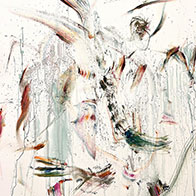
In addition to their space in Copenhagen, BORCH Editions presented their bold, large-scale projects at their gallery in Berlin from 1999 through 2023, which allowed the studio to further increase the scope of their art-world audience on a global scale. Borch Jensen was introduced to Tacita Dean (b. 1965) at the turn of the millennium, and together they went on to produce monumental, multipart prints like Quarantania (2018), which stretches across twenty-five feet and was based on a found nineteenth-century photograph. Reconstructions (2007) by Huma Bhabha (b. 1962) likewise employs the photogravure technique, but juxtaposes these prints with those that are created via woodblock, showcasing the numerous methods of production available to artists at BORCH. Working with the studio since 2015, Julie Mehretu (b. 1970) has produced prints that complexly layer the artist’s signature marks and are, like her paintings, expansive in scale. Across the exhibited works, No Plan at All emphasises these often prolonged collaborations, which have allowed both printer and artist to expand their practice and – reciprocally – to learn from each other. Cementing their reputation locally and regionally throughout Scandinavia, BORCH Editions has partnered in recent years with artists such as Mamma Andersson (b. 1962), Andreas Eriksson (b. 1975), and Frida Orupabo (b. 1986) to produce a diverse array of prints that employ a wide variety of etching techniques, alongside photogravure, woodcut, and monoprinting.
On the occasion of the exhibition, Utopia Editions will debut four etchings by the London-based artist Nick Goss (b. 1981), which he created at BORCH Editions.
Sign Up & Never Miss a Show