Open: Tue-Sat 11am-7pm
8 Queen’s Road, Central, Hong Kong, Hong Kong
Open: Tue-Sat 11am-7pm
Visit
Lucio Fontana: Spatialism. Pioneering the Contemporary
Hauser & Wirth, Hong Kong
Artist: Lucio Fontana
-
THU 17
SEPadd to calendarLucio Fontana: Spatialism. Pioneering the Contemporary
5-7pm
Hauser & Wirth, 8 Queen’s Road, Central
‘I pierce this canvas that was the basis of all art and I have created an infinite dimension. The idea is right there, it is a new dimension corresponding to the cosmos.’
- Lucio Fontana
Hauser & Wirth Hong Kong presents a major exhibition by Argentine-Italian artist Lucio Fontana (1899 – 1968). Titled ‘Lucio Fontana: Spatialism. Pioneering the Contemporary’ and featuring seminal works from 1949 onward, the exhibition focuses on Fontana’s revolutionary Buchi (Holes) and Tagli (Cuts), tracing the evolution of the Spatialism movement he founded and his radical exploration of the canvas as a site of infinite possibility. Breaking the boundaries between painting and sculpture, Fontana transformed the canvas into a dynamic area of light, gesture and movement. His punctured and slashed surfaces, central to Spatialism, fundamentally redefined the relationship between artwork and space. Through an innovative aesthetic, his visionary practice paved the way for postwar contemporary art and continues to inspire artists around the world.
Curated by Luca Massimo Barbero, in collaboration with the Fondazione Lucio Fontana, the Hong Kong exhibition marks the last highlight of a trilogy, following presentations in Los Angeles (2020) and New York (2022 – 2023). A major new publication on Fontana is forthcoming from Hauser & Wirth Publishers on the occasion of the exhibition. This volume marks the first widely available introduction to the artist’s practice in Simplified Chinese, offering Chinese audiences a comprehensive account of his groundbreaking career spanning from the 1920s to late 1960s, alongside specifically translated writings by the artist.
About the Exhibition
The exhibition begins its journey in 1949, the pivotal year that saw the birth of Fontana’s revolutionary Buchi (Holes) series. Initially perceived as a scandalous gesture, the act of piercing the canvas transcended all pictorial limits, opening up a positive, futuristic dimension that connected art with the concept of infinite space. The presentation traces the original conceptual development of the Buchi across his career into the 1960s, including one of the very first and unique perforated papers on canvas, rare terracotta spatial constructions where painting and sculpture uniquely merge, and the late pierced works.
By the late 1950s, this relentless experimentation led to his internationally acclaimed series Concetti Spaziali, Attese (Spatial Concepts, Expectations), famously known as the Tagli (Cuts). For Fontana, who was then in his 60s, these sharp, elegant slits were more than a mere gesture; as he declared: ‘My cuts are a philosophical expression, an act of faith in the infinite, an affirmation of spirituality.’ These iconic Tagli originated in experimental gestures and incisions first made on canvas-backed paper and on canvases treated with highly diluted aniline paint. They later evolved into more precise and conscious cuts executed on canvases prepared with monochromatic water-based paint. In these works, the cut acquired a more clearly defined formal role, becoming a constant point of reference for the avant-garde artists of the 1960s. The exhibition brings together a significant selection of works from this series, alongside the emblematic Quanta, created between 1959 and 1960, a series of shaped canvases, slashed or more rarely perforated, that anticipated the American shaped canvas movement and exemplified absolute freedom in spatial arrangement.
Throughout the presentation, the installation underscores Fontana’s masterful exploration of matter, light, and space through the diverse and multifaceted series of works that define his Spatialist practice. Works utilizing pure white, deep black and metallic colors like gold and silver react dynamically with the surrounding environment activating changing perceptions of light, surface, and space.
Presented in close dialogue with these spatial paintings are the Nature (Natures) series, conceived between 1959 and 1960 and comprising a group of bronze sculptures of geodesic, organic forms resembling terrestrial or extraterrestrial spheres. Modeled and punctured with immense physical effort by the artist to represent the unknown, these sculptures embody what Fontana described as ‘still forms with a dream of bringing inert matter to life.’ Together, they showcase the exhaustive richness of his Spatialist period, confirming Fontana as a true precursor of our contemporary world.
Bookshop
-
 Lucio Fontana
Immaterial: Lucio Fontana Ceramics
Other Media, Robilant+Voena
£47.00 : Robilant+Voena
Add to cart -
 Ugo Mulas
Ugo Mulas: Creative Intersections
Other Media, Robilant+Voena
£45.00 : Robilant+Voena
Add to cart -
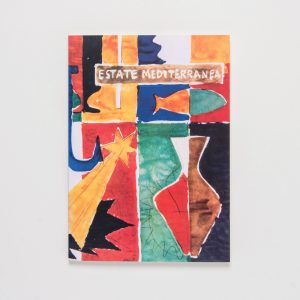 Gio Ponti
Estate Mediterranea
Exhibition Publication, Repetto
£20.00 Out of Stock: Repetto
Read more -
 Robilant + Voena
Italian Postwar Sculpture
Exhibition Publication, Robilant+Voena
£25.00 : Robilant+Voena
Add to cart