Kelly Beeman stands before a vast mosaic from the fourth century CE in the Villa Romana del Casale in remote Sicily. The mosaic depicts hunters capturing live lions, tigers, elephants, antelopes, ostriches, and other wild animals from distant parts of the Roman Empire. Men load the beasts onto ships to be transported across the sea to arenas like the Colosseum for venationes, where they were hunted and killed in front of thousands of spectators. She carries her future son inside her and the spectacle of ancient far off adventures compels her to contemplate her own journey into the unknown, that of becoming a mother.
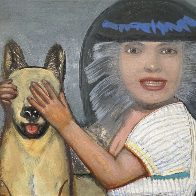
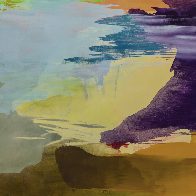
When Beeman returned home, she began a series of drawings, a selection of which are on view at Perrotin Gallery, Tokyo, as part of Overflow. Her central protagonists emerged: her signature oval faced woman with almond-shaped eyes and an elongated nose has now become a mother with the addition of a young boy, a stand-in for Beeman’s own. In turn, these drawings developed into a series of large-scale paintings in the cool palette of water, muted lapis, slate, violet, lavender, and sage green. These works are an allegory for the profound changes women undergo during motherhood. In Beeman’s words, “Overflow describes the magnitude of an experience that cannot be adequately described in words or even in paintings, to something so immense it spills out and bleeds into everything else.”
In the weeks leading to birth you realize that you are not in control. You cannot control your body nor how the baby will arrive. When the baby comes you feel an overwhelming love and crippling responsibility for this helpless new life. Exhausted, you realize that you didn’t truly understand what tired meant until you became a mother. Time slows down and speeds up again. Sometimes the nights and days blur together, but the seconds and minutes seem to last forever. You could stare at his sleeping face for an eternity. Life is no longer about your own wants and needs but that of another. His cries alarm you but you start to distinguish between them: hunger, wanting to be held, frustration, and the most awful, pain. As these shifts and disruptions take place, it is as though you are caught in the middle of a storm. You cannot control the weather but you must do what you can to weather it.
In First Rain and Rain Cloud, mother and son embark on their own adventure, as gray clouds appear overhead. At first they are protected under a playful, two-toned purple and white umbrella, but as the rain intensifies, the land swells, and the water rises. They find themselves Underwater, fully clothed, surrounded by lush sea grass, her hair swept upwards as she clutches her child. There are two versions of Underwater: in the pen and ink drawing, mother and son are surrounded by a school of fish; and in the painting they are surrounded by purple flowers while a red and black striped snake lurks below. The fish are innocuous new neighbors, but the snake threatens to tangle them further into the water’s depths. While ominous, the snake symbolizes a kind of transformation through its shed skin, just as a woman sheds her past self as she becomes a mother. To be under water describes the feeling of being overwhelmed, stressed, and drowning in work or parenting, another email to answer, another diaper to change, and another sleepless night. To be underwater is also to experience weightlessness, like astronauts training underwater to mimic being in space. The mother and son inhabit a floating world of beauty and danger but they are untethered and she must come up for air to save her son and herself.
During the Edo era when Japan was isolated from the rest of the world, ukiyo-e artists depicted the floating world of their surroundings, from geisha, kabuki actors, and sumo wrestlers of the red light district, to the everyday moments that made up urban life, including mothers and their children. Japanese master Kitagawa Utamaro focused his compositions on faces and torsos, rendering quiet intimate scenes such as a woman combing her hair, mothers breastfeeding, carrying babies on their backs, and rubbing their sleepy eyes. These mass produced prints were largely consumed by the increasingly wealthy merchant class, which occupied the lowest class within the social hierarchy of Tokugawa era Japan. In the late 19th century, when Japan opened up to the rest of the world, the prints became inspiration for impressionists such as Mary Cassatt and Berthe Morisot not just in subject matter, but composition and color.
There is a kinship between Utamaro’s flat perspectives, bold colors, clean lines, and depictions of mothers and babies to Beeman’s long limbed mothers and sons. Utamaro and Beeman share additional affinities through their use of pattern and focus on clothing. Utamaro beautifully captured kimono textiles, utilizing negative space and foregoing traditional black lines to delineate numerous patterns from ikat to undulating waves and simple dots. Beeman too builds upon her work in high fashion with bold red and black checkered blankets, polka dots patterns, the petals of golden flowers, and the concentric rings of leaves and grass. Like motherhood, these associations cross time and geography through generations of mothers and generations of sons.
In Carrying, Beeman portrays a woman, her face soft and her gaze neutral in a ruffled black dress with blue polka dots. She carries her son and they have emerged from the flood, almost naked, only his bright red underwear peeking out from behind her. He is not a baby, perhaps 9 or 10, his thigh almost the length of hers. Her hidden right arm supports his weight as he leans his head into her neck, she seems to support him easily. And isn’t that how it is with children, that you are carrying them even when they are too large to be carried? At first you carry him inside of you. Then he is so small you can cradle him in one arm, head in your hand, his back against your forearm. As he grows you learn to carry him in different ways: you brace him against your shoulder and rub his back to calm him or burp him. He is in a carrier now against your chest and will only fall asleep with you standing up, hips swaying side to side. As he grows, you can now carry him one handed, his legs wrapped around your hip. As he gets bigger, and he starts walking, he still wants to be carried. Sometimes you lie on your back and lift him high like an airplane, his laughter ringing in your ears.
Flight in the form of a dragonfly, swans, and hummingbirds appear throughout several works. Mute Swans are invasive to the United States, yet they inhabit numerous parks and lakes. Once a swan finds a mate, they are bonded together for life. They raise their cygnets together, building a nest and incubating the egg. Parents often carry young cygnets on their backs for warmth and safety. Hummingbirds are among the smallest birds in the world. Vibrating mid-air, their small delicate bodies whiz past at dizzying speeds. Seeing the world through your boy’s eyes, you see things from his perspective too, the colors, the surprise at something he’s never seen before. How do birds fly? How do they fly so fast? The world is full of wonders, bright, beautiful, and scary. In Baby Bird, the young boy cups a white baby bird in his hands. You’ve heard that baby birds that have been held by humans will be rejected by their mothers and you feel a pang of regret, yet your son cradles him so softly, you wish this to not be true. You can’t protect him forever, but you can try.
The mother and son are safe now, they have escaped the flood, the waters recede and their familiar surroundings, the house, fence and trees appear again. Still partially submerged, the world around them is recognizable yet different. The mother wraps her son in a blanket in Swaddled. You remember how the faded hospital blanket with its pattern of small foot prints proved to be the best swaddle. You practice folding the square fabric into a triangle and creating a perfect cocoon for your child snug like a caterpillar. Often he squirms his way out of the swaddle and his little arm sneaks out and you have to swaddle him again. You check to see that he is indeed still breathing. You realize you will do anything for this boy and this thought exhilarates and frightens you. Sometimes you don’t recognize yourself and who you have become.
The mother Beeman depicts is both universal and personal, a symbol of courage to go beyond one’s self towards the unknown. In each piece, she captures the fleeting wonders of life from the feeling of your child asleep on your body to the buzzing of a dragonfly. Taken as a whole, the works tell the story of a seismic shift into motherhood, through a flood, a rescue, and its aftermath into a world that is familiar and yet has irrevocably transformed. Standing before the paintings in Overflow, like Beeman standing in front of the Great Hunt in Sicily, we are awed by one of life’s greatest adventures.
Tomoko Kanamitsu
all images © the gallery and the artist(s)