Ely House, 37 Dover Street, W1S 4NJ, London, United Kingdom
Open: Tue-Sat 10am-6pm
Artist: Georg Baselitz
I was born into a destroyed order; a destroyed landscape, a destroyed people, a destroyed society. And I didn’t want to reestablish an order: I’d seen enough of so-called ‘order’.
— Georg Baselitz, 1995
Thaddaeus Ropac presents an exhibition dedicated to Georg Baselitz’s Hero paintings, bringing together key works from this breakthrough series of the artist’s formative years. Widely regarded as one of the defining achievements of his early career and a landmark in post-war European painting more broadly, the series established many of the visual motifs, concepts and existential themes that would go on to shape the trajectory of the artist’s practice. With loans from major institutional collections, including Tate, Landesmuseum für Kunst, Museum Frieder Burda, Museum Küppersmühle Duisburg and Berlinische Galerie, as well as the artist’s family holdings and private collections, The Heroes is the first exhibition in the UK devoted exclusively to this body of work.
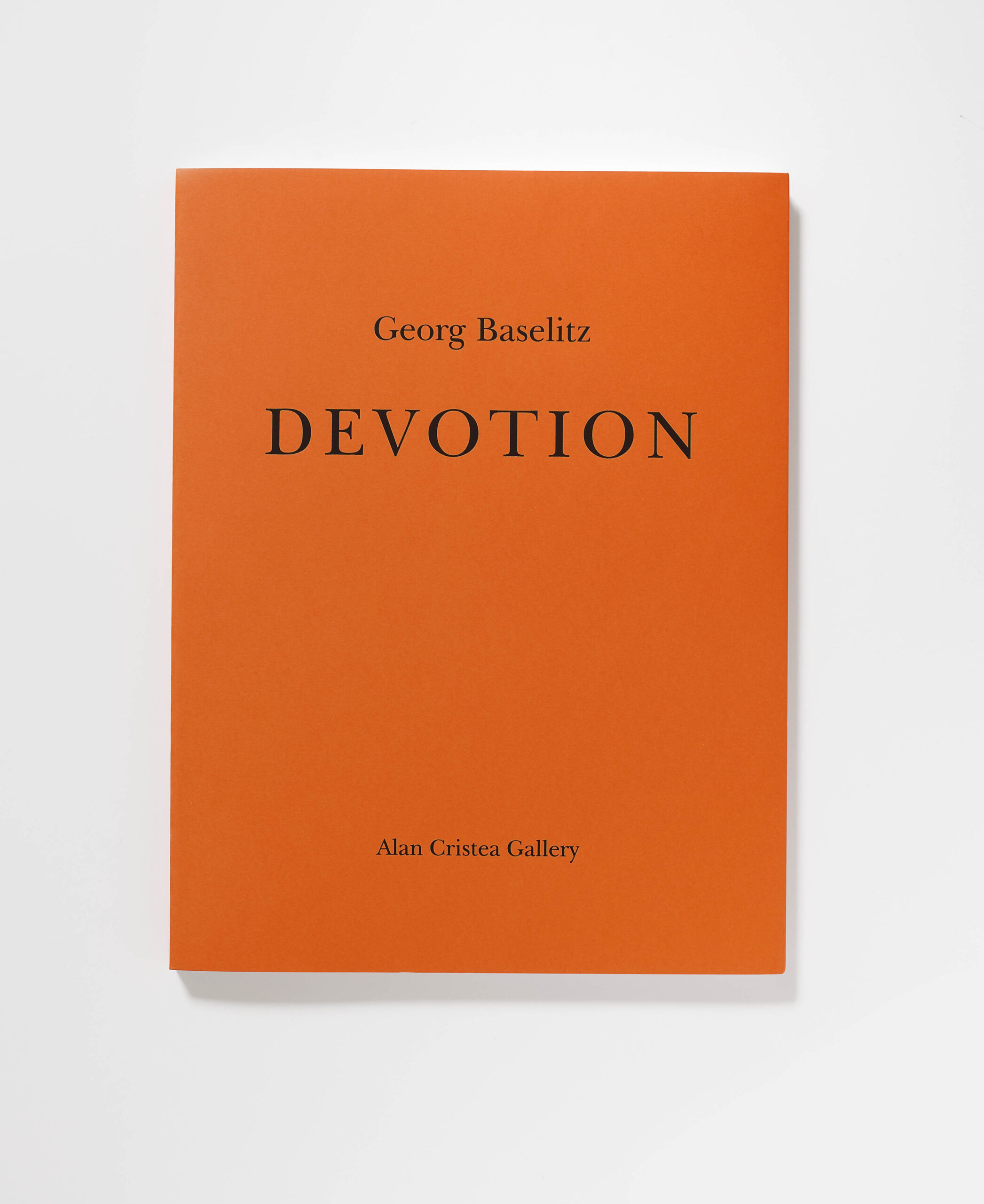
The exhibition is accompanied by a catalogue featuring an essay by Max Hollein, Director and CEO of The Metropolitan Museum of Art, New York, originally written on the occasion of Georg Baselitz – The Heroes at the Städel Museum, Frankfurt, in 2016, the first comprehensive museum presentation dedicated to the series, which later travelled to Stockholm, Rome and Bilbao.
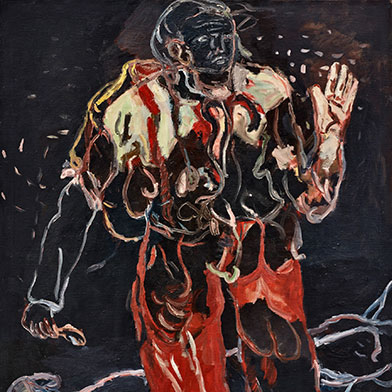
Created during a period of intense productivity between 1965 and 1966, when Georg Baselitz was just 27 years old, the Hero paintings marked a turning point in the artist’s practice. Rejecting both the prevailing optimism of the post-war era and the dominant artistic currents of the 1960s, he forged a singular figurative vocabulary through which to confront the realities of post-war German society and interrogate the place of the artist within it. The central motif of this series is a cast of monumental, ambiguous figures set within ravaged landscapes. They sit or stand aimlessly in no man’s land, displaced between past and present. ‘They’re not heroes swinging their fists,’ he stated, ‘they look broken, destroyed, ragged, tattered. And that’s how I wanted them.’
Georg Baselitz began working on the Hero paintings in the summer of 1965, shortly after completing an artist’s residency at Villa Romana in Florence. There, he had been inspired by 16th-century Mannerist prints, feeling a strong affinity with the distorted – or, as he described, ‘excessive’ – figuration of artists such as Pontormo and Parmigianino. Over the course of a single year, he produced approximately 60 paintings, 130 drawings and 38 prints in quick succession, each centred on a solitary figure of epic proportions, barefoot and dressed in rags or torn military uniforms. While these protagonists assume a range of archetypal roles – partisan, rebel, painter, shepherd and poet – they are defined not by heroism but by vulnerability and defeat. Their oversized hands clutch at broken tools or paintbrushes, bleed from stigmata-like wounds, or appear trapped in the ground.
Refusing to be co-opted by any single artistic ideology or political system, Georg Baselitz chose instead to embrace the contradictions and ambiguities of the present. As a young man in East Germany, he rejected the idealised, chiselled figures sanctioned by Socialist Realism, and in 1957 was expelled from East Berlin’s Academy of Fine and Applied Arts on the grounds of so-called ‘sociopolitical immaturity.’ Yet in West Berlin, where he studied at the Hochschule der Künste, and where he returned to paint the series after several months in Florence, his work was equally conspicuous, confronting the traumatic – and often unwelcome – events of recent history. As Max Hollein writes, in the mid-1960s the artist was painting ‘in the midst of the German economic miracle, in the midst of a spirit of departure, in an era in which people actually wanted to leave the past behind, and thought it was already behind them. In that situation, the Heroes probably looked like figures re-emerging, coming back out of a past people thought they had shaken off.’
When I started painting [...] I said to myself: if you paint a picture, it must not be a superfluous picture. You can’t paint a landscape, you have to paint something of global importance, something heroic… - Georg Baselitz, 2017
To many critics, Georg Baselitz’s commitment to figuration also appeared anachronistic. Throughout the 1960s, he worked consciously against the dominant international avant-garde movements of Pop art and Minimalism, as well as the various strands of Informel, Zero and Nouveau Réalisme that had emerged across Europe. At the same time, painting itself was widely perceived to be in crisis: some declared the medium exhausted, while others believed realism had been compromised by its association with totalitarian propaganda. Rather than abandoning painting, however, the artist grappled with its predicament directly, forging a path through its complicated history by working within its conventions. His isolated, dispossessed figures can be seen as projections of his own precarious position in the post-war cultural landscape, where to be engaged with painting and matters of representation was to be an outsider – the anti-hero rather than the hero.
Many of the Hero paintings undermine the male artistic paradigms that had been inherited from movements such as Abstract Expressionism and its critical discourse. Figures including Jackson Pollock and Willem de Kooning had been canonised not merely as painters but as titans of creativity, and the canvas itself became an arena of heroic ‘action’. Artistic genius was conceived in emphatically masculinist terms – at once virile, intensely physical and bound to the expressive gesture. Ein moderner Maler (A Modern Painter) (1966) invokes this mythology only to emasculate it. The dishevelled painter’s trousers are ripped open, revealing in place of a phallus a peetering spiral of flesh-coloured paint. In Spekulatius (1965), Georg Baselitz inscribes his initials over the hero’s crotch, provocatively gesturing towards a now defunct site of artistic origination.
Allusions to impotence and dysfunction recur throughout the series in the form of severed tree branches, stumps, broken ploughs, lowered flags and amputated limbs. The heroes are intentionally ‘androgynous figures,’ the artist explained, ‘[...] distinctly feminine, with women’s faces.’ With their disproportionately small heads, long graceful necks and flowing hair, some heroes evoke Italian Mannerist depictions of the female form. In Mit Roter Fahne (With Red Flag) (1965), the juxtaposition of pale flesh against rich crimson fabric even recalls the iconography established by Giorgione and Titian in their depictions of Venus. In 1. Kopf (1. Head) (1966), a rare composition that omits the hero’s body, this gender ambiguity is extended further.
Together, the works can be read as a manifesto – albeit an ambivalent one – on painting. While within the compositions, the tools of painting appear ostensibly broken and those who wield them are blocked, stuck or immobilised, the artist’s own fluid and expressive handling of paint nonetheless declared the medium capable of reinvention. This conviction is explicit in the text he wrote to accompany his debut exhibition of the Hero paintings at Galerie Springer in Berlin in early 1966, titled Why the Painting The Great Friends is a Good Picture!: ‘because there is more to the canvas than one might think. The principles of the picture – color, structure, form, etc. – are wild and pure.’
Through the Hero paintings, Georg Baselitz made conceptual discoveries that would prove foundational for the trajectory of his oeuvre: namely that representation is in itself a construct. As art historian Uwe Fleckner observes: ‘the hero only becomes a hero by means of a venerable reception and is – like history itself – the result of a construction subject to changing purposes and political intentions.’ The artist challenged the nature of representation further in 1966, beginning his closely related series of Fraktur (Fracture) pictures in which hero figures are sliced into horizontal sections and reassembled, as demonstrated by the works Der Halbierte (The Halved) and Drei Streifen - Der Maler im Mantel (Zweites Frakturbild) [Three Stripes - The Painter in a Coat (Second Fracture Painting)] (both 1966). From 1969, he would overturn the very premise of orientation, painting the first of his career-defining inverted compositions. The Hero paintings therefore marked a pivotal juncture in the artist’s career, establishing the conceptual foundations for a practice that would become one of the most singular and uncompromising of the post-war period.
Sign Up & Never Miss a Show