Sign Up & Never Miss a Show
- free weekly opening and closing emails
- free weekly exhibition selection emails
- save and favourite exhibitions
112 Waterbury Street, Brooklyn, NY 11206, New York, United States
Open: Thu-Sat 12-6pm & by appointment
Sat 19 Sep 2026 to Sat 24 Oct 2026
112 Waterbury Street, Brooklyn, NY 11206 — Google
Thu-Sat 12-6pm & by appointment
Artists: Diana Orving - Alicja Biała
Alicja Biała + Diana Orving: Aether’s Long Roots
6-9pm
CARVALHO, 112 Waterbury Street, Brooklyn, NY 11206
In The Mushroom at the End of the World (2015), anthropologist Anna Tsing describes how “pines, matsutake, and humans all cultivate each other unintentionally. They make each other’s world-making projects possible.” Rather than understanding ourselves as responsible for taming, mastering, and subjugating the natural world, Tsing encourages readers to see our interconnectedness with the environment as a foundational part of what it is to be human animals; more expansively, as thrilling, rangy, anarchic, capable of surprising convergences and new becomings. This attention to the unexpected interplay of beings, and the ways in which living things alter their surroundings unites the work of Alicja Biała and Diana Orving. Nature might revitalize human thinking, both artists imply, but such a realignment is only possible if we cease to see the natural world as merely a resource to be exploited. Both Biała and Orving reveal—with a tenderness, playfulness and ingenuity that matches their subject—the risks and rewards of our fundamentally and irrevocably interconnected lives.
Biała works primarily with acid-etched painting on brass, Orving with sculpted textile, but they share a deeply felt preoccupation with the natural world and our entanglement within it. Their works look toward instances of adaptation and resurgence that acquire a reparative force in our current context of climate catastrophe, pollution, and mass extinction. At a moment when the livability of the planet feels increasingly tenuous, there is a radical optimism to Biała’s and Orving’s perspectives, and to their attention to the simple yet consistently miraculous conditions of existence: the intelligence of a plant’s sensory networks; the body’s capacity to make and sustain new life. Their works insist upon the persistent, often improbable force of aliveness.
Each of the twelve panels of Biała’s seminal Beneath the Soft Ground, Hard Ground represents a month of the year and features specific plants known as hyperaccumulators, capable of absorbing and storing heavy metals from soil without being poisoned—continuing, in fact, to thrive. They have evolved an invulnerability, have invented a new form of survival and coexistence. We are confronted with scaled-up versions of these plants, their size lending them a totemic quality. They appear our superiors, having counteracted our ruinous actions and assembled defenses inconceivable to us, though this isn’t the line Biała takes. Instead, we see ourselves as alike to these plants by virtue of Biała’s medium. The polished brass reflects back dim fragments of those who regard it; rather than a distant, detaching viewing, this is an encounter that inevitably involves and implicates the spectator. Through this, Biała conveys something of our responsibility in this scenario, but there is an equal amount of hope: a sense that these organisms’ creativity could be ours too, if we only made an effort to harness it.
The acquisitive, extractive mindset of the Anthropocene is at the forefront of Biała’s thinking. Beneath the Soft Ground, Hard Ground and works from her Isolation series draw on extensive research into sites where industrial mining has heavily polluted land and water. Biała has travelled to contaminated landscapes across the United Kingdom and Europe and used the acidic water that gathers there as mordant in the etching process, binding the material production of the works to the environments they depict. The result is richly ambivalent, at once reflecting on the losses incurred by mining, and suggesting a constellation of emotions rarely associated with pollution: curiosity, wonder, and beauty.
Orving’s Lineage seems to occupy another register of this same terrain. Composed of seven biomorphic, fluid, gestural forms, it moves between states of recognition: organs or ligaments, submerged aquatic plants, bodies caught in some process of becoming. Hand-dyed in rose and beige tones, hand-stitched and hand-molded, the sculptures bear the intimate evidence of touch. They possess a tactile, fleshly grandeur, yet their presence is not wholly corporeal. Something in them seems to hover between the terrestrial and the atmospheric, as though matter were passing from one state into another. The title Lineage locates this ambiguity within time as well as form. Its sculptures can appear at once primordial and spectral, suggestive of what precedes the body and what might remain after it. Rather than illustrating a progression from one to the next, Lineage holds them in suspension, allowing origin and aftermath, density and diffusion, earth and aether to coexist within the same forms.
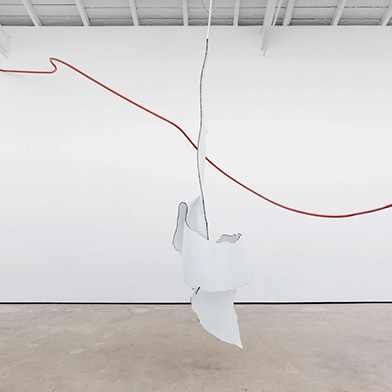
That suspension expands dramatically with Orving’s site-responsive installation extending through the adjacent gallery. Diaphanous textile sculptures meander and reach through the architecture, joined by gossamer passages that appear alternately to tether the forms and draw them outward. Their serpentine trajectories give the installation an almost searching quality: forms stretch towards one another, gather and disperse, occupying the space with an improbable combination of delicacy and scale. They seem less placed within the gallery than momentarily caught there, as though their movement preceded our arrival and might resume after we leave. Here the work’s associations remain fugitive. They bring to mind Old Masters drapery, angel’s wings, branching systems, an efflorescence of fungi, a shifting succession that resists categorization, never settling on a single form. Their translucency and suspension draw them towards the otherworldly, while their folds, cavities and connective passages return insistently to the physical. This oscillation between body and atmosphere gives Orving’s installation its peculiar charge.
Across the two galleries, a heightened physical awareness moves continually between the artists. Biała’s etched brass is hard, warm, reflective; Orving’s textile forms are yielding, porous, airborne. The former catches and fragments the spectator’s image, while the latter seems to solicit the body through scale and movement. In Biała’s Untitled diptych, hands and feet and limbs mark the surface, as though caught there like flies in a spider’s web, or like fish moving under a plate of suddenly frozen water. Orving’s sculptures, conversely, appear perpetually on the verge of escaping their material boundaries. Together, the works make perception bodily: surfaces return us to ourselves at the same moment that forms draw us beyond the limits of the recognizable.
Orving gives interconnectedness form through structures that seem alive—breathing, shifting, extending through space, like creatures whose origins remain unknowable. It is perhaps significant that Orving began developing this body of work during the first years of motherhood, newly attentive to the capacity of one body to bring into being, sustain, and transform another. Yet the works move beyond a literal maternal symbolism. Their connective structures propose lineage as something diffuse and multiple: an inheritance carried through bodies, environments and forms of relation, rather than a single, linear descent.
Biała arrives at a related understanding through the adaptive intelligence of plants. Could human behavior become as resilient and flexible as the branches of a tree, as persistent and adaptable as mushrooms, as collaborative and non-linear as a rhizome, as open to dissolution and reassembly as weather? Such questions move through the exhibition without resolving into prescription. Instead, Biała and Orving offer encounters with bodies and ecosystems already engaged in these processes—absorbing, mutating, sustaining.
Aether’s Long Roots, an exhibition featuring Polish multimedia artist Alicja Biała and Swedish sculptor Diana Orving, opens at CARVALHO the evening of Friday, September 18, from 6 – 8pm, with the artists in attendance. Comprised of acid-etched paintings by Biała and site-responsive suspended textile sculptures by Orving, the exhibition spans both gallery spaces across 110 and 112 Waterbury St. in Brooklyn. Aether’s Long Roots marks Orving’s second exhibition with CARVALHO and Biała’s first US gallery show. The exhibition remains on view through October 24, 2026.
Text by Rebecca Birrell, PhD.
Alicja Biała's installation, Beneath the Soft Ground, Hard Ground, has been loaned by the Adam Mickiewicz Institute, Poland.
Sign Up & Never Miss a Show