L.A. Louver is deeply saddened to announce the passing of artist Tony Berlant, after an extended battle with Alzheimer’s disease. He was 85 years old, and is survived by his wife Helen Berlant, daughter Kate Berlant, and brother Jeff Berlant.
Berlant was born in New York in 1941 and moved to Los Angeles with his family at a young age. As a senior in high school, Berlant would traverse Los Angeles and Pasadena, visiting art galleries and museums, a time he revered as the last heyday of Abstract Expressionism. “I would see every show twice. Look at everybody’s picture and read everybody’s bio. I was very focused and I had a terrific time,” he recalled in a 1988 interview.
Berlant received his earliest recognition as an artist in 1960, when Clement Greenberg selected one of his paintings for inclusion in an exhibition of L.A. artists at the Los Angeles County Museum of Art. In 1964, LACMA awarded Berlant the New Talent Purchase Grant.
From that period, Berlant worked between New York and Los Angeles, though he considered Los Angeles “his village.” It is where he met Marcel Duchamp, partook in existential conversations with fellow artists at Café Tasco on Venice Boulevard, and created lasting friendships with artists Ed Moses, Vija Celmins, Ken Price, Charles Garabedian, Gwynn Murrill, Chris Burden and Nancy Rubens, Jimmy Hayward, and architect Frank Gehry, among many others in the burgeoning and vibrant art scene. Berlant was also admired and befriended by key curators and museum leaders including Evan Maurer and Paul Schimmel, and he held close relationships with collectors and art patrons such as Jay Last, Dallas Price, Thom Weisel, Dick Fredericks, and Paddy McKillen.
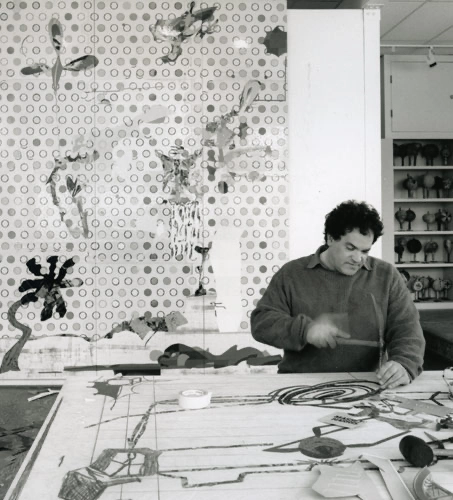
Considered a “master of painting without paint,” Berlant was best known for his technique of collaging found and fabricated printed tin with steel brads onto wood panels, an art form he first explored in high school. Tin became his primary medium in 1963, when he began collecting metal signs used for advertising at a nearby corner market. Frames, houses, doorways, and windows were prevalent subjects throughout Berlant’s artistic career, metaphors Berlant described as “transitions between life and death, the secular and spiritual world.”