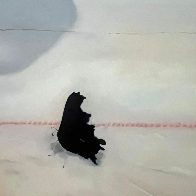
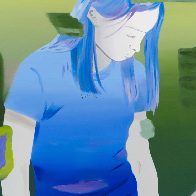
Working on unprimed jute canvas, Bengtsson applies acrylic with a dry brush, slowly rubbing pigment into the raw fibres. Rather than building an image through conventional layers of paint, Bengtsson explicitly leaves the process exposed, allowing forms to accumulate gradually and transparently. Like an excavation site, the resulting works possess a tactile, faded quality, appearing at once newly made and recovered from an archive. Some forms are fully uncovered and clearly rendered; others reveal the process, with traces, tools and remnants left exposed.
The relic is central to Bengtsson’s practice. Archaeological remains offer fragments from which an entire object, body or event must be reconstructed; a fossil, likewise, is both evidence of what existed and an imprint of what is no longer there. Bengtsson’s paintings operate within the same tension between presence and absence. Figures, objects and environments seem to disintegrate and emerge at once, producing images that are recognisable yet persistently elusive. The works can be understood as future relics: objects that appear to have been recovered from an uncertain time and place.
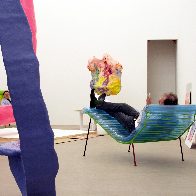
In Bagatelle, the distinction between process and result remains deliberately unresolved. Bengtsson introduces custom-built display tables that occupy an ambiguous position between sculptural object and functional support. Their angled surfaces recall both an architect’s drafting table and a medical dissecting table, while also evoking the beds used in operatic staging. The two paintings presented on these structures depict different versions of The Healing of the Paralytic at Capernaum, a biblical episode in which Christ instructs a paralysed man to rise, take up his bed, and leave. The angled supports thus acquire an additional narrative dimension, connecting the paintings’ biblical imagery to the exhibitions larger interest in theatrical mechanics. Mounted on wheels, the structures retain a sense of impermanence, as though they might be rearranged at any moment. The paintings rest directly upon these structures, appearing suspended between their completion and a continued state of becoming.
Drawing on his medical education, Bengtsson explores how scientific knowledge is constructed and communicated, where rigorous observation and speculative invention can coexist within seemingly authoritative frameworks. Borrowing from Bronze Age burial practices, medieval science, and contemporary scenography, his mises-en-scènes form an amalgamation of references with personal memories, anecdotes and fragments of information gathered over a lifetime. Rather than treating historical and scientific sources as fixed knowledge, Bengtsson filters them through imagination and recollection, allowing facts to shift and transform through the process of retelling, like a childhood game of telephone.
The interplay between historical narrative and theatrical construction is particularly evident in Backstage Behavior, which depicts a hectic town square populated by intertwined human and animal forms. Architectural elements suggest a constructed stage, and a figure appears to pass through a doorway whose boundaries coincide with those of the painted space. Renaissance-inspired clothing adds a historical, theatrical note, while the entangled bodies reflect Bengtsson’s sustained interest in anatomy and physical relationships. The scene becomes a place of exchange and transformation: information passes between individuals and is altered along the way, reflecting the exhibition’s broader interest in the instability of knowledge.
“I paint like an excavation. Plastic paint on canvas. The tip of the brush coating the fibers. Preserving and digging out form. Finding a subject that is in flux. Barely coherent. In the process of becoming or coming apart. Making it sticky. encapsulated. Figures with a stiff anatomy. Digging out wooden spoons, splinters of a house. A germinal chaos. At a point of catastrophe or having undergone a calm death. All of them are made from grids. The grid is the internet research and visual archives. Painting is talking with the grid as words. To say the words in new tonations, to muffle some words. To divide the words into sounds. Some loud, some whispers. Inaudible speech about a familiar subject. Painting like Klee’s gray point jumping beyond itself. Painting until it feels foreign to myself. Like a relic. Like a person painted like an object. Our cultural and scientific history is held together by spit and glue. People steal the bricks from big churches to make their new driveway. DIY solutions to big problems. Cutting a toe off a big statue to fit it for shipment. To bend a form to fit it for the painting. I like that aesthetic diagrams are the easiest to remember. I like that fun facts are the easiest to remember. I paint what i think someone once told me. The echo of the original story put on tape.”
- Victor Bengtsson
Victor Bengtsson (b. 1997, Copenhagen) paints as a form of excavation. His work draws on archaeology and the logic of display, alongside music, scientific history and visual archives, which he substitutes with memory, anecdotes and invention. Figures, objects and settings appear caught between formation and disintegration, as future relics that seem to have been recovered from an uncertain time, or half-remembered from a story once told. Bengtsson’s works are a labyrinthine simulacrum: a maze of illusions filled with heavy archetypal symbols and figures that exude meaning, even as the rationale for their interconnectedness has fallen apart.
Recent solo exhibitions have been held at Albion Jeune, London (2026); Andersen’s Contemporary, Copenhagen (2025); O-Overgaden, Copenhagen (2025); Public Gallery, London (2024); Mendes Wood DM, Brussels (2023); Mendes Wood DM, online (2022); and Mendes Wood DM, São Paulo (2021). Group exhibitions include dépendance, Brussels (2025); Public Gallery, London (2025); Someday Gallery, New York (2024); and Den Frie Centre of Contemporary Art, Copenhagen (2020). Bengtsson looks forward to forthcoming exhibitions in Sweden and New York (2027), and a major public commission in Denmark (2028).
all images © the gallery and the artist(s)