Sign Up & Never Miss a Show
- free weekly opening and closing emails
- free weekly exhibition selection emails
- save and favourite exhibitions
Brunnenstrasse 170, 10119, Berlin, Germany
Open: Wed-Fri 11am-6pm, Sat 12-5pm
Artists: Matteo Montani - Barbara Boekelman - José Angelino - Alessia Armeni - Remy Hysbergue - Antti Pussinen - Markus Keibel - Saverio Tonoli - Antonello Viola
Curators: Luisa Catucci and Melania Rossi
for Heather Cotè, fellow citizen of Elsewhere
Text by Luisa Catucci
There is a place that has no coordinates. It opens whenever the body stays and the mind does not: in the middle of a conversation, a room, a street corner, while something else, unnamed, pulls attention sideways. We call it Elsewhere, as if it were a location we might one day reach. It is not. It is a condition, permanent and quietly ungovernable, the low hum underneath presence itself.
This condition is not abstract in the same way for everyone. For those shaped by multiple origins, multiple languages, multiple departures, as in my own case, elsewhere is not a metaphor but a form of nostalgia that never resolves: a longing for the other where, idealized, imagined in absence, the place one can no longer fully inhabit even upon return, precisely because the other elsewhere is already calling us from the other side. Belonging, once split this way, never fully reassembles.
The concept for this exhibition, curated together with Melania Rossi, draws quietly on something of that condition: a sense I personally have carried since childhood, of never quite belonging entirely to one place and one culture, later sharpened by the shared restlessness of the expatriates. The permanent search for another, better elsewhere where that interior conflict might finally resolve. A Neverland, in the end, more than a destination.
Not every artist here shares that particular biography, though some do. But the condition does not require a passport stamped with departures or international origins. It lives, just as truly, in the creative impulse itself: in the instinct to abstract, to distill, to carry a feeling across the gap between what is imagined and what can be shown. Every act of translating experience into shape, color, sound, or gesture is already a small voyage, a way of reaching for an elsewhere that raw experience alone could never reveal.
The Ubiquity of Elsewhere brings together nine artists who work moved by these very dynamics. None of them sets out to represent a specific place, a sound, a landscape, a moment literally. Each one translates it instead with poetic instinct: soundscape becomes image, movement becomes horizon, landscape becomes energy, perception becomes atmosphere. What survives is never documentation but something closer to what memory leaves behind, or a dream, or the pull of a fantasy of escape: the afterimage of something that had already moved on by the time it reached the surface.
Walking through the exhibition’s rooms makes all of this manifest.
The first room holds two artists, facing each other, each defined by their own way of losing solid ground. Tonoli’s mountains, like Keibel’s silk, both rise from water, the surface itself doing the creative work, color and form arriving by flotation. Water, here, is not a place but a vehicle, the means through which earth, sky, and universe find a way to speak to each other.
Saverio Tonoli paints in the tradition of ebru, floating pigment on water and coaxing it into shape before the sheet or canvas ever touches the surface. The mountain arrives not from a brush but from a negotiation between his gestures and something considerably wetter. He never touches the image directly, but his hand accompanies every detail, more midwife than author, a midwife who by now has delivered enough mountains to know exactly which way to nudge the labor along. And here and there, caught inside a bubble or hidden into a swirl, something watches you from within the folds, the color, the water’s own hiding places: perhaps some old deity already living in the landscape, using the water as the one door through which it can manifest for an instant, before withdrawing and hiding again with equal ease. A peak crystallizes out of near-blank white at the top, composed, almost dignified, then loses all composure further down, dissolving into swirling, near-psychedelic bursts of red, blue, and ochre, less a mountain than the vision of one, imagined by a mind that has wandered considerably too far from fixed, familiar coordinates and shows no particular interest in wandering back. It is the kind of landscape where old gods might still be loitering, bored out of their immortal minds, occasionally amusing themselves by rearranging a cloud or two just to see if anyone below notices, which, of course, nobody ever does. Elsewhere, for Tonoli, is not a place fully arrived at but a landscape caught permanently mid-formation, in a state of exalted alteration, suspended forever between reality and the water’s own revealing tricks
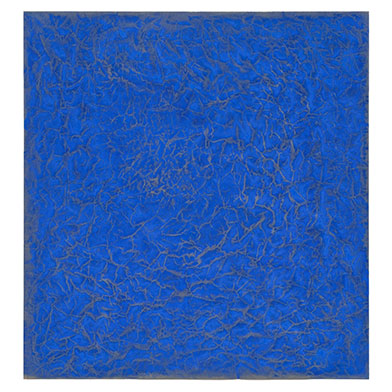
Markus Keibel paints on silk, continuing an old tradition, though the material, contrary to what your average silk robe might object, has never been just a fabric. From the sacrifice of one devoted, hardworking worm, dreaming, presumably, of something considerably bigger than its own cocoon, an entire road was born. A road for two far strangers to finally find each other. Silk and spices went first, religions followed, hitching a ride without asking permission, ideas came too, the kind that had struggled getting to the next village and suddenly discovered how far they could go. Painting on it now, Keibel is simply the latest traveler setting out on that silk road, carrying nothing but pigment and the same ancient hope that whatever waits at the other end is worth the journey, might this time at least, be called a friend. That same road seems to run straight through the painting itself, which splits into two fields of blue rather than one. One half is dense, dark, the Grand Bleu kind of blue, the sort that doesn’t so much frighten you as take you by the hand, whispering that down is actually the friendlier direction, that somewhere past the last breath a person simply stops needing to be a person and can become everything else instead, water and depth and the cosmic wholeness underneath it all. The other half stays paler, cooler, tipping toward violet, still standing at that same threshold, coat still half on, working up the nerve before diving in. Somewhere beneath the surface, a faint shape timidly surfaces, perhaps a face, gone again into the depths before it can fully reveal itself. Elsewhere, for Keibel, is that threshold itself, the fine line that manages to connect and divide in the very same breath, the point where the old road finally ends and becomes a portal instead to infinite dimensions and possibilities.
Stepping into the front room of the gallery, the show flings its horizons wide open. The works of Antonello Viola and Matteo Montani face each other across the space, two alchemical searches, set face to face, with enough room to breathe, enough to stop behaving like paintings and start behaving like landscapes touched by something far larger than themselves.
Antonello Viola doesn’t paint islands so much as distill them, the way a perfumer reduces an entire field of flowers to a single, precious drop, until an entire island coastline is reduced to nothing but its purest emotional essence, holding everything that place was ever capable of stirring in the soul. Geography, here, was never really the point, but the muse. In a very elegant way, both works on view, Isola di Tavolara and Venezia, are built from several glass panels of uneven height, staggered and overlapped rather than lined up in any orderly formation: the charm of ancient layerings of history and chaos, in the Italian manner. As if the place itself had freed itself from the unworthy rectangular constraint of the classical painting and insisted, loudly, on being grandly reassembled from quarreling, harmonious fragments that simply couldn’t agree on scale. Distilled on glass, with gold leaf as its base, Viola’s colors vibrate like the Italian sun itself, never willing to stay politely hidden behind a cloud for long, breaking through layers of blue, turquoise, and yellow. Viola captures light exactly the way memory captures one absurdly vivid detail, a scent, a particular slant of afternoon, letting everything else around it go soft and relative. Oil, pencil, and gold settle onto the glass the same way a place settles into the mind long after you’ve packed your bags and said goodbye to it. Elsewhere, for Viola, is not a place with borders, but the residue it leaves on the emotions, once its details have been let go, quietly, deliberately.
Matteo Montani is an alchemist of a different order, a handler waiting to see what the reaction between his elements hands back, as if they had opinions of their own and a lawyer ready to enforce them. Where Viola distills an entire place down to its essence, Montani expands it starting from just a few things: a little oil, a little metal dust, turpentine, the kind of ingredients you’d find in Paracelsus’s kitchen, and “cooks” them until the expansion fills the entire surface. Ancient, primal materials. Stardust asking, politely, to go home. Rather than apply it, Matteo negotiates for it, bargaining with gravity and evaporation the way one bargains with fate itself, until the material surrenders and starts finding its own way back toward the celestial spheres. Mist that seems exhaled rather than painted, a dawn or a dusk caught mid-breath, gold flecks suspended exactly the way light stays motionless in that instant before the rain finally loses the strength to stay held inside the cloud that contains it. Every particle homesick for the place it originally fell from. Every sky he paints carries that same devotion, like a hymn sung under one’s breath to no one in particular, and yet somehow, unmistakably, heard. There is no specific place to identify, no cloud with a scientific name, no coordinate worth marking on any map, only the old, familiar vertigo of standing beneath something immensely vast and forgetting, for a moment, gloriously, every earthly point of reference. Elsewhere, for Montani, is the place he himself has called living between the eye and the soul, where a sky stops behaving like scenery and starts behaving, quietly, like an act of devotion.
Coming down the stairs, something quieter and discrete awaits: Armeni and Keibel, on opposite walls, both working in a single dominant hue divided by hard, exacting geometry, though nothing about the effect is remotely similar, one might hurt your elbows, the other your head.
Alessia Armeni paints her own studio ceiling, though never by looking up. Something of a queen of the ground mirror, she tilts one flat on the table until it frames exactly the fragment of ceiling she’s after, the fairest in the whole kingdom, or so the glass seems to insist, and paints it from the reflection rather than the source, a kind of plein air turned upside down and kept indoors. The studio, for a painter, has always been an elsewhere on its own, the one room built entirely for the imagination to run loose in. Armeni draws out its very last place in it where anyone would least think to look for inspiration: in the hidden corners overhead, or rather, underfoot in the glass, a mirror that holds the truth of those planes and angles. Seams painted in a sober, minimal range of ancient rose and muted gray, tones so delicate to underline how most people spend an entire lifetime beside the quiet wisdom of their own ceiling, that discreet master of physics, without ever once noticing the beauty and knowledge she found there. Elsewhere, for Armeni, is exactly that inversion: a room turned into a landscape, a ceiling mistaken for a horizon, discovered only by looking at it sideways, through glass, upside down.
Markus Keibel brings his own borrowed material to the same stairwell, studies pulled from a Bible illustrated in 1880 by Gustave Doré, angels and sacred figures engraved with the patient, obsessive linework of a century that still believed images could be trusted to explain the divine. But Keibel doesn’t leave that linework alone. He submerges it, entire, in the same deep blue that upstairs in Future Friends 1, served as a window onto possible expanded Elsewheres. Maybe, these sacred images might be one of the possible destinations reachable through it. Across the surface of the paper, hard geometries and lines stand like scaffolding built to hold up a ruin, a present-day necessity keeping the old image on its feet, one that left alone would never survive the evolution of time. Even the scratches that surface here and there read like the sound of an old apparatus straining to reach the present after a hundred and forty years of the signal evolving and retuning.
Further down the room, the ceiling drops and the light goes soft. The room doesn’t leave landscape behind so much as strip it down to what was always moving underneath it, the forces a landscape lets you feel or hear even when there’s nothing left to look at. Fittingly, the two artists sharing this room come from opposite ends of the European continent, José Angelino from Sicily, Antti Pussinen from Finland, as if to prove that the forces in question move through geographical elsewheres without ever needing a passport, any more than they need a frame. What lives here isn’t visible by nature. It has to be caught, coaxed, or forced into some material that will finally let it show itself.
José Angelino builds small apparatuses that seem to have wandered out of a science that hasn’t quite finished arguing with itself, an alchemist’s bench dressed up as minimalism. Blown glass, brass, steel, mercury, electricity, joined into shapes almost embarrassingly domestic: a glass dome that could pass for a jug if it weren’t currently occupied with a small, private storm inside itself; a tile marked with a glowing X, its four arms meeting at a cluster of bubbles that pulses like a heart still undecided whether to trust the body it beats inside of. Electricity moves through all of it in plain sight, a thin blue arc leaping the gap inside the dome, a warm orange current running the full length of the X, a storm caught mid-sentence, still undecided how to end its own story. Nothing here represents electricity. It simply happens, live, magnificently indifferent to whether the room bothers to watch. Elsewhere, for Angelino, is not a destination, not a geographical place. It is the current itself, the good old principle of energy moving through matter, older and more stubborn than any word ever invented to explain it.
Elsewhere, for Angelino, is not a destination, not a place you could point to on any map ever drafted. It is the current itself, the old, unglamorous, entirely physical fact of energy moving through matter, a weight the body has always recognized in its bones long before the mind got around to inventing a word polite enough to hold it.
Antti Pussinen hunts a principle near to that same restlessness Angelino chases: sound, an even harder animal to track down than electricity, since it has the nerve to vanish the instant it’s born. Or so it seems. Pussinen, in fact, catches a few of those waves before they can slip away from human hearing, pinning voice and frequency to paper in a process somewhere between physics and photography, the kind of process in which a scientist and a painter might, for once, find themselves agreeing on the method.
What comes back is never simply the image of a sound the way one expects it, clean and orderly. It’s closer to the aesthetic of a distortion in space and time: black lines that coil in on themselves, double back, refusing every invitation to behave like something so obedient as a clearly defined shape.
In truth, a sound wave even when not trapped on support, never really vanishes. Once past the threshold of human hearing, it propagates beyond the atmosphere, continuing into the cosmic dark, infinitely, never stopping. Which would be an excellent reason to be careful on deciding what to send out into the air. And what a poetic gesture, then, that of all the sounds worthy of being expanded forever into the cosmos, Pussinen chose the best one there is: the word love. Crystallized in a handful of languages, the photogram of each syllable stitched to the next by a single ribbon of color, one shade per language, love, sounding like a completely different animal in every tongue, carrying its message from the gallery wall straight to the center of the universe. Elsewhere, for Pussinen, is the exact, fugitive instant a wave stops being air and becomes something the eye can finally admire, if only for as long as the paper, or the color running through it, agrees to keep holding on to it.
By now elsewhere has changed shape more times than seemed possible, water, sky, current, sound, wind, geometry, and in the back room downstairs, Barbara Boekelman and Remy Hysbergue offer one final dialogue, no less fitting than the rest.
Barbara Boekelman‘s Menace to Society keeps its readers anchored to the page, seated on the ground, with an almost beach-like ease, while the world around them blooms into a wild personification of flowers, palm fronds, and tangled branches, one that could just as easily seem to spring directly from the pages they’re reading. A Garden of Eden evoked, splendid, almost too good to be true, or an actual idyllic place to finally sit in peace and silence, undisturbed by anything, immersed in printed words and thoughts. Reading seems to be the most literal elsewhere possible: a body stays still, a mind wanders between the lines, though from outside nothing appears to be happening. But whoever has learned to disappear into their own book, silently, even if only for an afternoon, has also learned something considerably more dangerous than mere escape: that doors exist where they say there are only walls. First, the door opens in the mind, its hinges oiled by nothing more than attention and a little imagination. Minds, though, are notoriously bad at keeping secrets from the rest of the body, and sooner or later the same feet that never left the garden start getting ideas of their own, wondering what it would feel like to actually step through that door instead of admiring its craftsmanship from behind the pages. That is the menace the title is pointing to: not the daydream itself, but the small, stubborn question it eventually asks: why is that door double-locked, and who holds the keys? Elsewhere, for Boekelman, is the door itself, the one a book opens behind the eyes, the mind slipping through it while the body stays exactly where it was left, calmly finishing the reading.
Remy Hysbergue builds a surface the way a volcano builds a landscape: abruptly, passionately, unapologetically. First comes a soft but intense light, almost artificial in appearance, the kind no ordinary day could ever imitate: the cloud of fine ash an eruption leaves suspended in the sky before a single grain of solid matter has even bothered to reach the ground, Ash still undecided what to make of gravity. Then come the lighter deposits, broad, overlapping layers drifting down like lapilli do once the mountain has made its intention known, settling in a fine, even layer over everything, unhurried but steady way, in no rush to completely bury the landscape just yet. Finally, with considerably less courtesy, comes the real weight: three-dimensional blocks of color, closer to a lava flow than to anything normally found in a tube of paint, gathering and stiffening into ridges that hold their shape exactly where the material lost its momentum. In the darker works, that same underlying glow catches pale bands of color the way moonlight catches waves at night, each one caught mid-motion, mid-break, frozen the instant before crashing against the rocks. Elsewhere, for Hysbergue, is exactly that: a motor impulse caught at its most stunning moment and crystallized, still and yet somehow still moving, magnificent and powerful and entirely unapologetic for its own eruption.
Together, Boekelman and Hysbergue turn the room into a tropical journey: Krakatoa meeting the Garden of Eden. A dreamlike place, in the end, where an opening mind stops being a metaphor and starts becoming a genuine emancipation, an expansion no longer imagined but already underway.
A last work by Matteo Montani waits at the bar, the gallery’s final room. A sky at sunset, color melting from gold into deep, intense blue, the exact moment just before night finally takes over. The whole day’s journey through the elsewheres closes here, precisely at the hour when the sky quietly stops being one thing and becomes another.
Sign Up & Never Miss a Show