Sign Up & Never Miss a Show
- free weekly opening and closing emails
- free weekly exhibition selection emails
- save and favourite exhibitions
9 Bury Street, SW1Y 6AB, London, United Kingdom
Open: Mon-Fri 10am-5.30pm
Artist: William Klein
Stand S07
The Mayor Gallery in collaboration with Grob Gallery announces its participation in Frieze Masters 2026 with a solo presentation of William Klein’s early abstract works, made between 1952 and 1964, in the fair’s Spotlight section. Before Klein became one of the most influential photographers of the twentieth century, he was an abstract painter and it was in the space between painting and photography that his radical visual language was born. This presentation brings together the paintings, photograms and abstract photographs in which Klein first set images in motion.
Situated at the front of the stand is Turning Panels (1952), a major installation conceived for the fair. Originally commissioned by the Italian architect Angelo Mangiarotti as a series of pivoting room dividers, the painted panels became a prominent shift in Klein’s career. Photographing the panels as they rotated, Klein caught their hard-edged geometries dissolving into blur, painting morphed into kinetic sculpture, and a new, dynamic abstraction was born. At Frieze Masters, visitors are invited to rotate the panels and step through Klein’s kinetic threshold to discover the rest of the presentation inside. It is an encounter designed to be moved through, not just looked at, the painting becomes an experience.
The chance discovery that the camera could conjure an abstraction sent Klein into the darkroom, where he produced countless photograms in the spirit of Man Ray, experimenting with long exposures, light and movement. In 1954 he exhibited these abstract photographs alongside his kinetic panels at the Salon des Réalités Nouvelles in Paris.
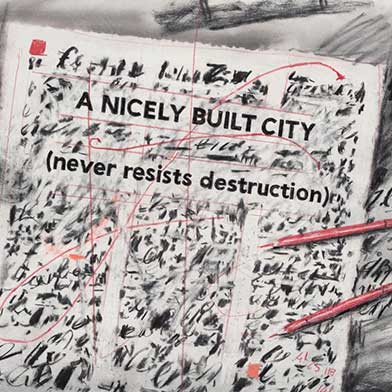
Three vintage silver gelatin prints, Blurred Squares, Paris (1952) and two works titled Abstract (1952), capture light in sweeping calligraphic strokes and geometries displayed at the scale of painting. They hang alongside two Untitled oils on board (c. 1952), whose hard-edged patterns and colour fields show Klein the painter at the precise moment the camera began to pull his geometry into motion. Lettrist project for a mural (1963–4), a bold typographic composition that looks forward to Klein’s lifelong fusion of image, text and graphic design, completes the full arc of the presentation, from paint to photograph to sign.
William Klein (New York, 1928 – Paris, 2022) was a photographer, filmmaker, painter and designer who transformed the visual language of the twentieth century. After winning his first camera in a poker game while stationed with the U.S. Army in postwar Germany, Klein moved to Paris under the GI Bill and studied in the studio of Fernand Léger, absorbing the influence of the Bauhaus and Russian Constructivism. Invited to Vogue in 1954 by art director Alexander Liberman, he took fashion photography out of the studio and into the street, and went on to produce era- defining photographic books on New York, Rome, Moscow and Tokyo. Where his contemporaries sought harmony and decisive moments, Klein embraced collision, fragmentation and visual noise — and generations of photographers, filmmakers and artists continue to draw on his uncompromising vision.
William Klein’s work is held in major public collections worldwide, including the Maison Européenne de la Photographie, Paris, which preserves more than 336 prints, vintage publications and films; The Museum of Modern Art, New York, which staged his major 1980 retrospective; The Metropolitan Museum of Art, New York; the Centre Pompidou, Paris; and the Stedelijk Museum, Amsterdam. Further notable holdings include the National Portrait Gallery, London; the J. Paul Getty Museum, Los Angeles; the Art Institute of Chicago; and the National Museum of Modern Art, Tokyo.
Sign Up & Never Miss a Show