+44 7437 531161
Open: Thu-Sat 12-6pm & by appointment
Visit
Open: Thu-Sat 12-6pm & by appointment
Unit T, Reliance Wharf, 2-10 Hertford Road, N1 5ET, London, United Kingdom
Open: Thu-Sat 12-6pm & by appointment
Visit
Jessica Sarah Rinland: Mutual Interruption
Alma Pearl, London
Thu 10 Sep 2026 to Sat 24 Oct 2026
Unit T, Reliance Wharf, 2-10 Hertford Road, N1 5ET — Google
Thu-Sat 12-6pm & by appointment
Artist: Jessica Sarah Rinland
Alma Pearl presents a solo exhibition by Argentine-British artist and filmmaker Jessica Sarah Rinland (b. 1987), marking her first collaboration with the gallery. Invited by artist Lyndon Barrois Jr. as part of the conversations they have developed over the past two years, Rinland presents a selection of works from her ongoing project Mutual Interruption, which explores the ethics of photographing animals.
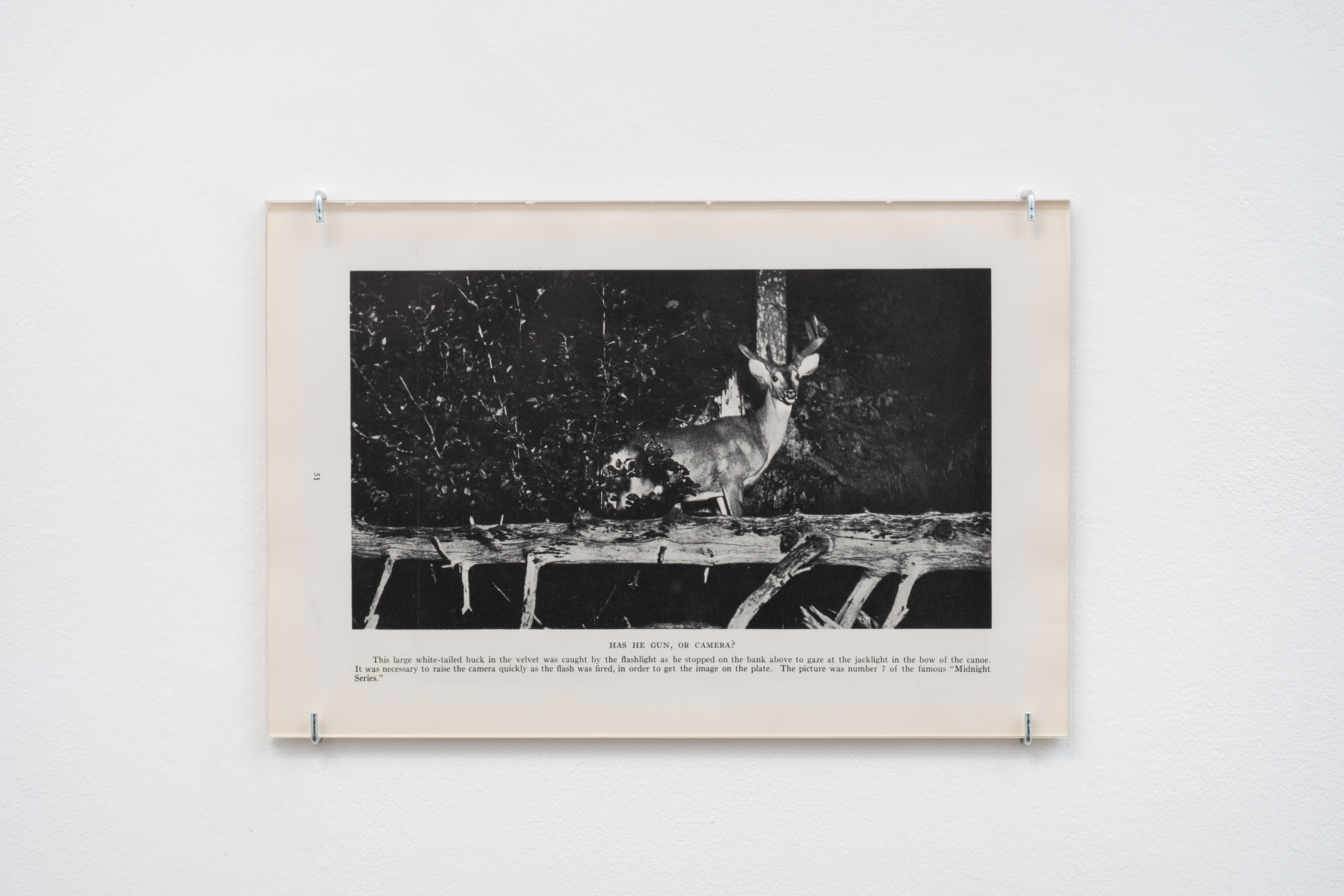
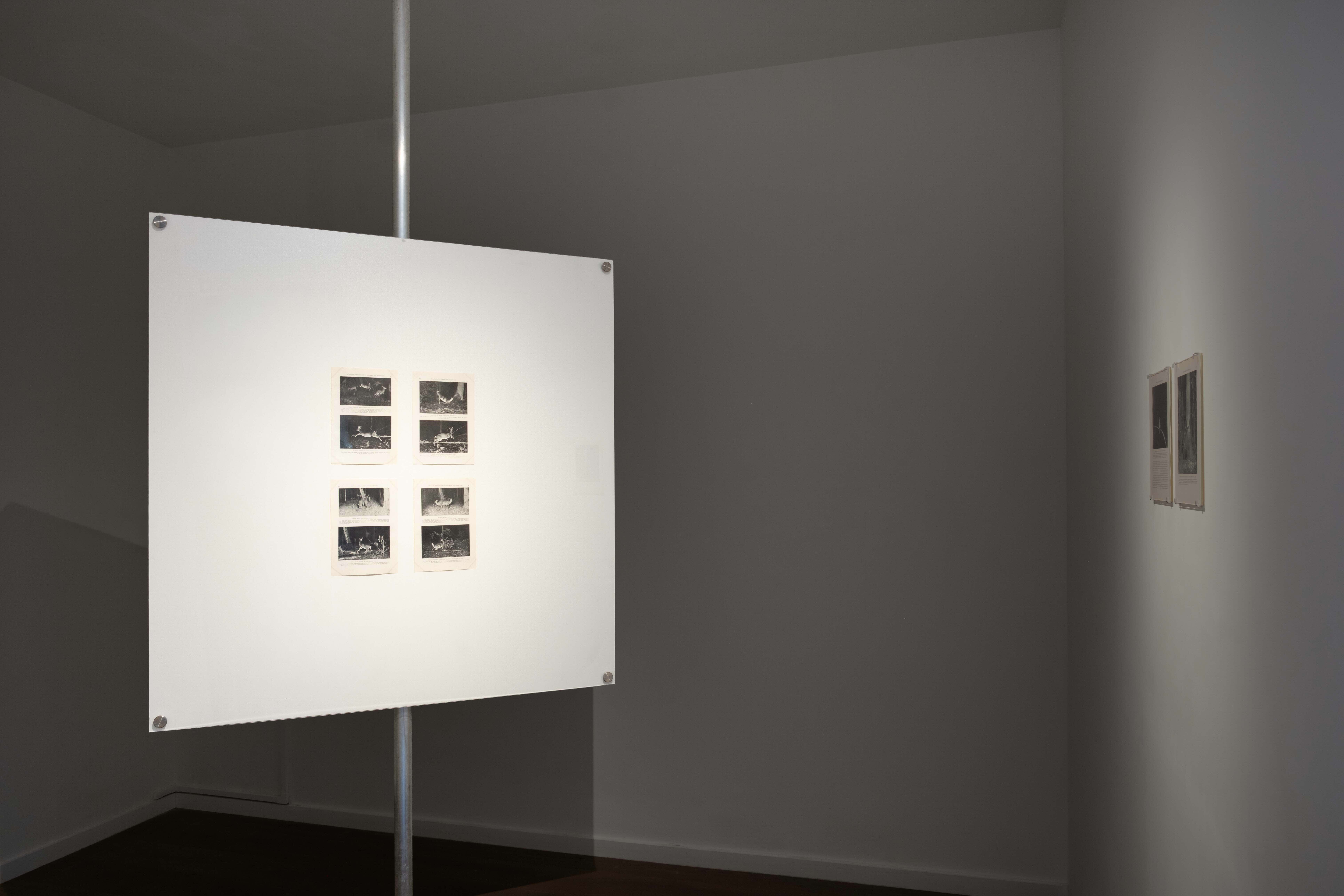
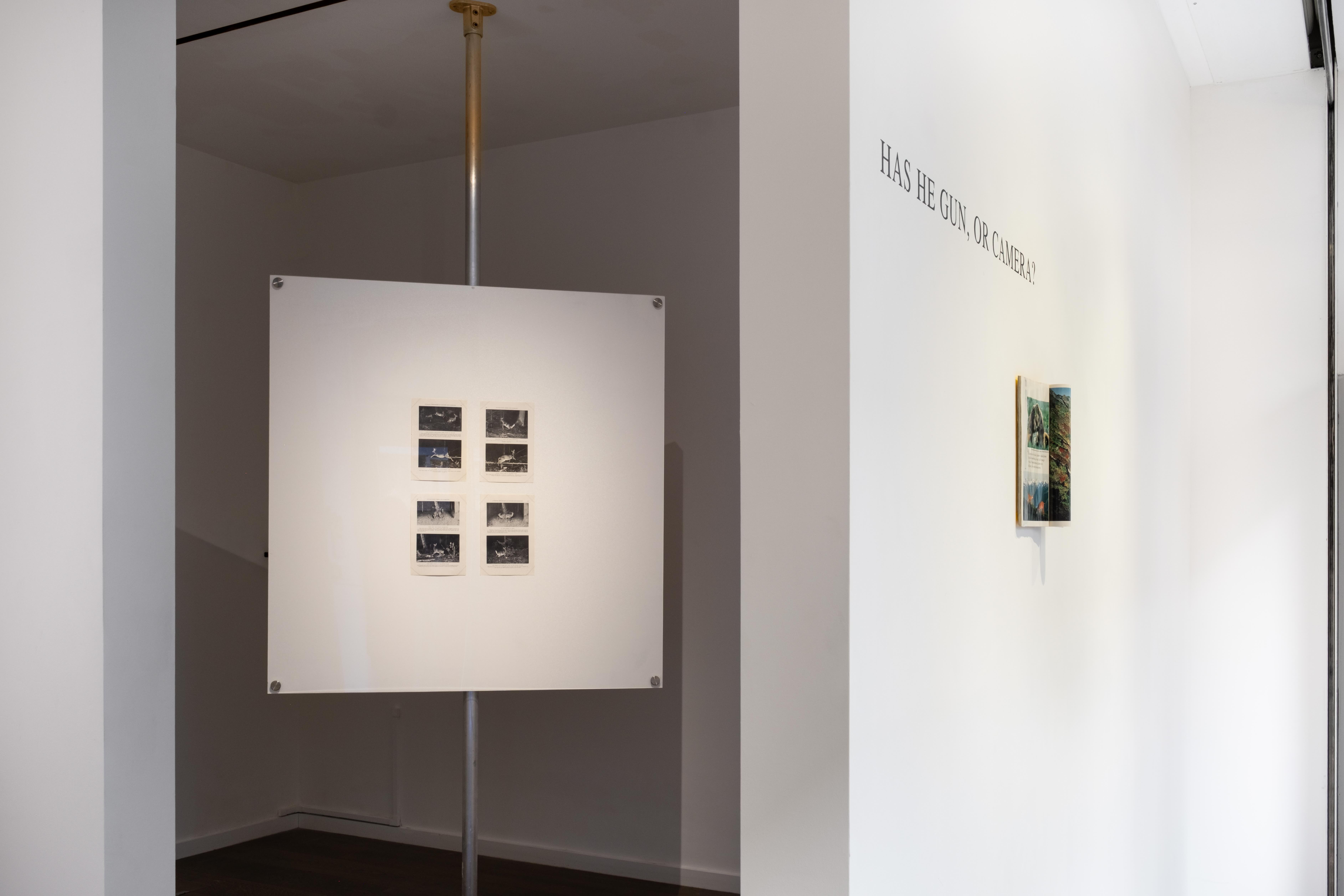
For the exhibition, Rinland brings together an almost museological presentation of archival material alongside a new sound work incorporating autobiographical recordings and quotations drawn from a range of sources, from National Geographic to more specialised scientific journals.
“Has He Gun or Camera?” reads one of the photographic captions describing a majestic deer staring directly at the camera in Upper Michigan. The question gives voice to the sentient animal, caught in a moment of uncertainty: is it about to be photographed or shot? Like the other material presented in the exhibition, the image is drawn from the anthology Hunting Wild Life with Camera and Flashlight by American naturalist and wildlife photographer George Shiras 3rd, first published in 1935.
George Shiras 3rd (1859–1942) is widely recognised as the inventor of the camera trap and known to have taken the first nocturnal photograph of an animal. He championed photography as an alternative to hunting, proposing that images could be shared with “many thousands the world over”—transforming the act of trapping an animal into an offering that could circulate and endure. Shiras appropriated the use of fire in the hunting practices of the Ojibwe people of the Great Lakes region of the American Midwest. In this tradition, a controlled flame is held at the bow of a boat as it moves across the water. The fire entrances the prey, while the reflection of the light in the animals’ eyes guides the arrows—or, in Shiras’s adaptation, triggers the flash and shutter of the camera.
In the sound piece Mutual Interruption, Rinland combines her personal recollections of encounters with animals with readings of historical and scientific texts. The two voices–both that of the artist and Fabiana Portoni, Conservator at the Natural History Museum–shift between intimate memories and clinical descriptions of animal behaviour in front of the camera:
My eyes continued transfixed on the primate’s repetitive gesture, while my hand moved only slightly to take my phone out of my pocket, to lift it and point its lens at them. Abruptly, the mother turned her head to look at me through its glass, and stopped picking. The infant followed her turn, glaring into the device. I reacted, immediately putting my phone down. I did not dare film them. We made eye contact for a few more breaths before they moved away, hiding beyond my visibility. I was uncomfortable having interrupted a moment between two monkeys who seemed to not want to be captured, again.
Later that year, I stood, at first sunlight, with my feet and tripod legs submerged in the wetland of Los Esteros del Ibera, as mosquitoes quickly suckled my calves. I was incredibly close to a heron, she did not flinch, she stayed in her rested position, the position I hoped to film her in. As soon as I pressed my index finger on the trigger to start rolling my Bolex H16, she strained her neck to search avidly for the unfamiliar mechanical hum. Noticing it came from my manipulation of the camera, she glared at me through the lens, then immediately scuffled away.
This would be the last time I would ever capture an animal.
Across Rinland’s practice, questions of preservation, conservation, and repatriation recur, revealing how gestures of care can simultaneously expose and reproduce histories of violence. Through the juxtaposition of archival images, historical texts, sound, and personal material, Mutual Interruption considers the uneasy relationship between looking and taking, documenting and capturing, protection and control.
Jessica Sarah Rinland (b. 1987) is an Argentine-British artist whose work explores and interrogates archives and institutions, the tactile labour that occurs within them, their replicas and representations, the scientific world whose knowledge informs them, and how that knowledge is constructed, complicated, and disseminated. Her work culminates primarily in film as well as in installation, photography, sculpture, and artists books.
Rinland’s work has been exhibited internationally, including solo exhibitions at Tabakalera, San Sebastián, Spain (2024), and the University of Tennessee Downtown Gallery, Knoxville, USA (2021), as well as group exhibitions at the Museum of Contemporary Art Cleveland, USA (2022), Southwark Park Galleries, London, UK (2021), Taipei Biennial, Taiwan (2020), National Gallery Singapore (2021), Somerset House, London (2016), and New Contemporaries (2011).
She is a recipient of numerous prizes including Special Mention at Locarno (2024) and San Sebastian Film Festival (2024), Best Film at DocumentaMadrid (2019, 2024) , Primer Premio at Bienale de Imagen en Movimiento Buenos Aires (2019), and Massachusetts Institute of Technology’s Schnitzer prize for excellence in the arts (2017). She has had retrospectives of her films at Flaherty Film Seminar, Anthology Film Archives, Open City Documentary Festival, Doc’s Kingdom. Residencies include DAAD, Camargo Foundation, Film Studies Center at Harvard University, Somerset House Studios, MacDowell, and Ikusmira Berriak. Her films are held in the British Film Institute and MoMA.