In antiquity, grafting bordered on sorcery; it was an act of mysterious horticultural creation. To graft was to join what was separate and encourage new growth, specifically in plant propagation. It provided an intervention that could produce something which was hybrid and unexpected.
Bloom takes the idea of grafting a step further. It considers what might emerge from these unions of knowledge and material. The emphasis shifts from the graft itself to the growth that follows: emergence, unfolding, expansion and transformation.
Growth Spurt | Essay by Yvette Dal Pozzo
Something is growing in Lynda Draper's works. In this new exhibition, titled Bloom, we are witnessing an artist on the move, learning, collaborating and transforming. Draper, one of the country's best known, most distinctive practitioners working in ceramics, is embracing new materials and integrating them closely in her works, namely bronze and glass. In many ways, these materials share transformative qualities with ceramics, with both involving enormous amounts of heat and energy, undergoing considerable transformation, and resulting in works that contain a touch of magic.
The new works boldly combine disparate materials, ideas and reference points through Draper's distinctive interpretive lens and visual language. The resulting exhibition features artworks that coalesce seamlessly, with each component interdependent on the other.
Draper has been working at the top of her field as an artist, innovator, mentor, leader and instigator for over forty years. She has a clear and decisive vision and a unique and recognisable voice that connects her practice. Despite this singularity, Draper is skilled at collaborating with specialists to expand her practice and outcomes. Her openness, generosity, curiosity and a willingness to learn has led to incredible and diverse outcomes.
Draper's imagination and curiosity started from an early age. The artist recalls sitting in the back of her father's Holden Commodore on long, winding road trips on the school holidays. They would often deviate from their destination to view roadside icons and attractions, the stranger the better. This included run-down fun parks, a house made of bottles, and a warehouse full of crocodile skins. Draper recalls this fondly as a formative education, stating, “you have to use your imagination to populate these strange places”.[1]
What endlessly fascinated the artist about viewing these places is observing the unwavering creative impulse that runs through us all, with everyday people driven to create, collect and share art and objects with one another.
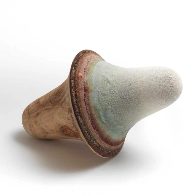
Draper too has always been a collector of moments, memories and ideas, which are stored, used, and recycled in an endless loop. Her practice has been full of shapes, colours and textures that appear and re-appear in new and different ways, building a unique vocabulary that has continued to evolve. In the exhibition Bloom we see some of these early references to innocent, child-like memories coming through with candy-like colour reminding us of Big Charlie bubblegum, Conversation Hearts and sherbet. The artist makes reference to these touchstones in works like Pod (2026) and Bubbles (2026), suggesting a sweet confection, a seductive form that draws us in.
Draper is not only influenced by her personal memories, but as an educator who served as the Head of Ceramics at the National Art School in Sydney from 2016 to 2023, she is deeply informed by history. She has a curiosity about the history of art, collecting, galleries and museums as frameworks for presenting and understanding the world around us.
This expands beyond visual art, looking at the way material culture, science and biology were historically interlinked and intermingled, with early examples of collections less focussed on accuracy and categorisation and more on intrigue and experience.
Draper has a particular fascination with the Wunderkammer's strands of ‘naturalia’ and ‘artificialia’. In the pursuit of eliciting excitement and curiosity, the custodians of these institutions would make their own hybrid animals and inventions to exhibit. Made from a conglomerate of parts from disparate animals, plants, fossils, artefacts and mechanical inventions, they brought impossible creatures and forms to life.
This reference is a historic mirror for Draper's own process in Bloom. A work like Apparition II (2025), which brings together a chalky matte white ceramic body with transparent coloured bubbles and streams of glass, stands like an imagined creature with eyes and orifices; a viewer could almost imagine it breathing. Through her combination of materials, forms and references, Draper has created works with diverse qualities, shapes and finishes that similarly activate the imagination and are a sight for viewers to behold.
The same wonder that drives a cabinet of curiosities, with disparate parts assembled and ordered into something new, also draws Draper to unique public monuments and to the visual language of how and why we express ourselves. Draper continues to collect reference points from a range of diverse sources, ranging from the wrought iron decoration found in the Palace of Versailles in Paris to an intricate pebble-crete mosaic picnic shelter found at a park close to the artist's home on Dharawal Country/Wollongong. Bloom contains works which draw on this idea of collecting and combining. Night Bramble (2026) links to this idea of drawing together jewel-like adornments and uniting them in a monumental work that addresses architecture, space and feeling.
In particular, she is inspired by monuments made by outsider artists with their meanings more elusive, personal and self-directed. These include the iconic Dreamer's Gate (1993–1997) by Tony Phantastes, a work which the artist was reacquainted with on a recent residency supported by Goulburn Regional Art Gallery in Collector, New South Wales. Draper has visited this surreal giant mesh and plaster sculpture regularly since the 1990s on road trips to the Snowy Mountains. Other touchstones include a suburban garage made of Cement Fondu near Tom Ugly's Bridge in Gadigal Land/Sydney; and the French postman Ferdinand Cheval's Palais Idéal (1879–1912), a palace made of pebbles. These are artists and creatives who often sit outside of distinct styles, movements and times, united by their obsessive impulse to create and express themselves.
Draper's interest in public monuments lends itself to her recent explorations in bronze. This is a recent innovation in her practice. She has collaborated with Nick Stranks of Carwoola Casting, located outside of Kamberri/Canberra, to work in this enigmatic and historically significant medium.
For Draper, who is always interested in using materials to their fullest potential, pushing works to the limit, bronze is an exciting medium not only because of its lustrous, seductive finish but due to its strength. In her ceramic work, Draper is known for her ability to build works that appear impossible to create. The artists works are often large-scale and feature undulating lines that hold their shape and balance, appearing to float. The result is something that only a master of the medium can achieve through patience and the key element of time. When the ceramic works are built up slowly and with skill, they are able to harden and gain the strength needed to support their long, looping limbs. To cast in bronze, Draper forms these adventurous sculptures in wax, then, using the lost wax method, casts the work in molten metal which solidifies into a material that is strong, weighty and permanent.
These bronze forms draw heavily on motifs found in the environment, appearing like tree branches, containing suggestions of wild new growth or branches overlapping. The combination of sensuous natural lines and forms made in a material which has such formal weight is a delight for the senses. The artist has rendered the material untethered and free.
Alongside bronze, Draper has also been developing a new relationship with glass. Her discovery of this material was born out of residencies, friendships and collaborations. In particular a formative six-week residency at Canberra Glassworks in 2024 saw her working alongside glass artists Annette Blair and Spike Deane, learning the process and possibilities of working with glass, and the other-worldly outcomes that can result.
The evidence of touch and the human hand immortalised is so important in Draper's work. A way this was preserved and extended in the medium of glass was the use of plaster moulds of fingers and fingerprints. As the blown glass forms are made, they are not perfect spherical bubbles, but are shaped, moved and marked by real hands and touch. In this medium the replica fingerprints become elongated, distorted, drawn out.
Glass has proven to be an effective medium in translating the many ideas and inspirations which have been building and layering for Draper throughout her life. This is paired with bronze's strength which serves as the perfect framework to support delicate plumes and bubbles of glass which sit in and amongst the sculptures.
This material exploration and sense of openness can also be seen in Draper's profound work, the titular Bloom (2026), made of both bronze and glass. At a staggering height, the form is a drawing in air, swirling and rising through space. Atop this monumental form a ghostly plume of glass is embedded as a budding flower, an ode to nature.
Crucially, this use of bronze and glass comes into direct conversation with ceramics throughout the exhibition, with each material drawn on for its own distinctive qualities, yet all appearing in conversation.
Texture and light dance across our eyes in this exhibition. Shiny bronze glazes like in Gold Bramble (2026), sit alongside restrained matte chalky forms like Polyp (2026). The subtle colouration and transparency of glass seems to glow and bounce light, in dynamic contrast to the ceramic hosts, whose textured skin and glaze serve to absorb light instead.
Colour too continues to be central to Draper's visual vernacular in the exhibition. At different moments this oscillates between pinks and oranges that are nostalgic and sweet, as seen in Phantom (2025). In other moments the artist is drawing on tones found in the environment like a rich dark emerald green glaze which recalls the stem of a rose as in Emerald Bramble (2026), and a pale bright blue glass form that looks like a pure sunny sky like in Cloud I (2026).
Bloom signifies a confident moment in Draper's new work, where conceptual and material forces have come to life. We see the result of rigorous testing, experimentation and growth. Moments of influence and inspiration gathered carefully over Draper's lifetime have come together to create work that is full of energy and vitality. It appears in this body of work that Draper's references, forms, colours and connections have all been waiting to come together in this moment, to be made visible, to bloom.
[1] Several references in this text are from a conversation between Lynda Draper and Yvette Dal Pozzo on 19 July 2026.
all images © the gallery and the artist(s)