Sign Up & Never Miss a Show
- free weekly opening and closing emails
- free weekly exhibition selection emails
- save and favourite exhibitions
64 Grosvenor Street, W1K 3JH, London, United Kingdom
Open: Tue-Sat 10am-6pm, Mon by appointment
Thu 8 Oct 2026 to Sat 14 Nov 2026
64 Grosvenor Street, W1K 3JH — Google
Tue-Sat 10am-6pm, Mon by appointment
Artists: John Hoyland - Clyde Hopkins
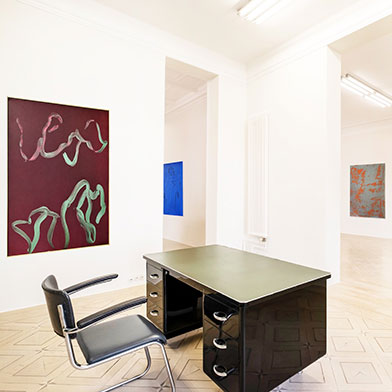
Upsilon Gallery presents The wind blows high in space, a two-person exhibition bringing together paintings and works on paper by John Hoyland RA (1934–2011) and Clyde Hopkins (1946–2018). Curated by Philip Dodd, former Director of London’s Institute of Contemporary Arts, the exhibition considers the artists’ shared engagement with landscape, weather, journeys and the sublime, tracing an artistic dialogue across two generations of post-war British painting.
Exhibition text by Curator, Phillip Dodd
The sky and beyond; weather; inner and outer space; journeys; the sublime and new kinds of landscape, painting in Europe and beyond – these are just some of the preoccupations of the paintings of John Hoyland and Clyde Hopkins in this two-person show.
In 1980 John Hoyland was invited to be the selector of the then Hayward Annual and chose Hopkins among other predominantly abstract artists to exhibit and to mount an argument with. At that time, art such as Hoyland's and Hopkins’ was largely still framed in terms of abstraction vs figuration, its indebtedness to Abstract Expressionism and claims about the autonomy of art.
Those arguments are long gone and it is now possible to grasp the larger ambition of these artists, one a generation older than the other. The exhibition’s title - ‘The wind blows high in space’ – points towards their intent and achievement. The title is taken from a piece of writing by Hopkins.
Artists have looked skywards for centuries, not least Turner and Constable, and we can now acknowledge that Hoyland and Hopkins belong to that longer Romantic history. As the critic John Ruskin said of Turner, ‘He rushes through the ethereal dominions of the world of his own mind’. The same might be said of Hoyland and Hopkins, reimagining the sublime for new times.
These two artists had access through the advent of space exploration to the grammar of the cosmos: from stars to galaxies. 1946 saw the first photographs of the arc of the earth beyond the clouds. This grammar is most evident in Hoyland’s magisterial later work but it is also there in Hopkins’ works on paper, paying homage to Miro, himself grappling with the language of the skies and beyond.
This is not to say either Hoyland or Hopkins is a ‘space artist’. It might be more apt, to quote the title of a study by Joseph Campbell, to suggest that both artists are reaching out to ‘the inner reaches of outer space’ – as were other European artists such as Fontana in his ‘Nature’ sculptures.
In a world where we look upwards for evidence of climate shifts and renewed space exploration and where we are haunted by the revenge of nature, Hoyland and Hopkins paintings look ever-younger, ever more resonant, ever more unmisgiving.
Sign Up & Never Miss a Show