Sign Up & Never Miss a Show
- free weekly opening and closing emails
- free weekly exhibition selection emails
- save and favourite exhibitions
19 East 64th Street, NY 10065, New York, United States
Open: Tue-Sat 10am-6pm
Artists: Willem de Kooning - Francis Bacon
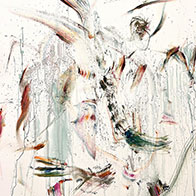
Lévy Gorvy Dayan presents Bacon / de Kooning. Taking place in the gallery’s 1932 Beaux-Arts townhouse, the exhibition juxtaposes the works of Francis Bacon and Willem de Kooning, two indelible figures of postwar art. The presentation focuses on their smaller-scale paintings of the late 1960s and 1970s—de Kooning at primarily 60 by 55 inches, and Bacon at his preferred 14 by 12 inches—each chosen by the artists for their deliberately human proportions. Through these canvas dimensions, both painters could concentrate their emotive forces and demonstrate their respective technical and gestural virtuosities, reaching a shared essence of figuration and abstraction.
Bacon and de Kooning famously encountered each other in 1975 in New York on the occasion of Bacon’s retrospective at the Metropolitan Museum of Art—a face-to-face meeting commemorated by a now iconic photograph. While the two artists met previously, knew of each other’s work, and possessed painterly affinities, they have long been positioned as painters staunchly working at alternate ends of the artistic spectrum—Bacon a champion of a heightened and existential figuration and de Kooning a pioneer of gestural Abstract Expressionism. Now, for the first time, Bacon / de Kooning will demonstrate their shared commitment to the medium of paint as a primary means of human expression.
The two artists arrived at their unique practices from different sides of the Atlantic and opposite ends
of the postwar art world—Bacon, the standard-bearer of the School of London, and de Kooning at the center of the New York School. In the years following the Second World War, both artists confronted the essential question of how to depict the human condition—after the ravages of war, the Holocaust, and the atomic bomb, at a moment when existentialism had thrown the meaning of human experience into doubt—and many of their contemporaries had abandoned the figure altogether.
Bacon historically has been read as the eminent figurative painter and de Kooning as the foremost abstractionist—yet this distinction dissolves under closer scrutiny. Publicly, Bacon was scathing toward abstraction, dismissing Jackson Pollock’s work as “old lace” and insisting that pure abstraction “always remains on one level.” However, his own figuration was itself a form of controlled distortion—with paint pressed into the service of what he called “the brutality of fact.” For Bacon, the artist was a “pulverizing machine” through which everything seen and felt was fed. His extreme distortion, in his words, “unlock[ed] the valves of feeling and therefore return[ed] the onlooker to life more violently.” In his hands, oil paint transformed the body into bruised flesh.
Meanwhile de Kooning arrived at abstraction through the figure—flesh became landscape under the sweep of his brush. His gesture never left the body behind so much as dissolved and reconstituted it. Bacon himself conceded that de Kooning was one of the few painters who could make paint work—a rare compliment from a man otherwise suspicious of Abstract Expressionism.
In the 1970s, de Kooning reached a new confidence of expression. Describing his practice during this period, he stated, “I made those paintings one after the other, no trouble at all. I couldn’t miss. It’s a nice feeling. It’s strange. It’s like a man at a gambling table [who] feels that he can’t lose. But when he walks away with all the dough, he knows he can’t do that again. Because then it gets all self-conscious. I wasn’t self-conscious. I just did it.” Art historian Dore Ashton wrote in 1975 of de Kooning’s creative outpouring, “There could be no quick perception, no general impression that could cover the wealth of experience reflected [in de Kooning’s recent paintings]... [He] maintains the singularity of intimate detail. In short, he offers a distinct, unique realm in which imagination prevails.”
Bacon too reached a zenith of his practice around the turn of the 1970s, creating increasingly small-scale paintings that possessed an extraordinary sense of individual presence. In these portraits, a face alone carried the force, vulnerability, and complexity of a full figure. Predominantly depicting his close friends and lovers, in addition to self-portraits, he largely worked from photographs and from memory rather than from life. Of sitters, he remarked, “They inhibit me in person because if I like them I don’t want to practice before them the injury that I do them in my work. I would rather practice the injury by which I can record them in private.” Bacon frequently painted his portraits as diptychs and triptychs, believing that multiple canvases conveyed different emotional and psychological states and relationships, and thus more complete representations of his subjects. The exhibition encompasses several examples of the artist’s single panels and triptychs—featuring Bacon himself and some of his closest muses, including George Dyer and Henrietta Moraes.
By examining the fertile period from the late 1960s through the 1970s, the exhibition will demonstrate the artistic affinities uniting Bacon and de Kooning. Further, as both artists sought to work at life size, Bacon / de Kooning will convey how the tightly prescribed formats led to a shared flourishing of creativity—with the more intimately scaled canvases demanding closer scrutiny and technical prowess from the artists and a similar intensity of interrogation from the viewer. We are especially grateful to the private collectors whose generosity has contributed to this landmark exhibition.
Sign Up & Never Miss a Show