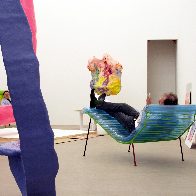
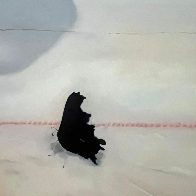
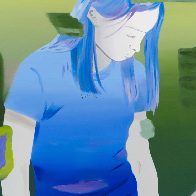
In Piraeus, the works are displayed throughout the gallery, beginning with a large series of new drawings at the entrance, while in the display window a donkey, with dimensions unusual for the artist, gazes out onto the street.
As has been the case throughout the evolution of his work over the past decades, the mood in this exhibition, titled Classics Illustrated, is deeply introspective, despite the theatrical nature of his work.
Like an observer appearing within his own work, he often makes an appearance, though more often than not he takes center stage as the hero of a theater of the absurd, scenes that seem strange, but are ultimately life itself.
The artist is first and foremost an illustrator, his canvases serving as a pretext and a space for storytelling.
The events are not always clear—at least not to the viewer. The bizarre and the absurd often appear within the context of everyday life, and like a muralist from another era, he frequently incorporates both the “before” and the “after” into the same work.
First, an explosion. A couple was sitting at the table, and now they lie sprawled on their backs on the floor; the house is in ruins, the table they were sitting at is crushing them, the walls are still collapsing, and a geometrically Mediterranean house can be glimpsed through an opening in the wall. Destruction and bodies, the same surface.
Although inspired by reality, the work cannot, however, be considered pure realism.
Second room: games and leisure time, activities that humans have been engaged in for thousands of years.
One work depicts the artist himself, seemingly sitting in a bar, watching a man undress, while in another room a large crowd is packed.
Across from him, a boat hovers in the void of the sea; on the shore, people appear to be fishing. A theatrical exercise in fishing and painting.
On the third wall, a man plays with a ball. A sketch developed on canvas.
Third room, interior scenes.
In an interior space, he writes down what they had said and what had happened back when the two of them—colossal figures—sat comfortably at the height of his memory, while he watched them from below.
Opposite them, a man in three acts, with the buildings as a backdrop, separates the inside from the outside by taking a leap into the void.
An unusual work, with surrounding works serving as observers and judges of a moment between two people, and a pot steaming on top of the armchair.
Through the opened door, a seaside landscape is revealed.
In the studiolo, two singers stand on stage, each singing their own songs.
Meanwhile, in the attic, three deeply existential works—introspective and somehow nocturnal.
One person is peeping.
One who reads to her before she goes to sleep.
And another one who is being mended or repaired.
Works of life that painting brings to life; silently, quietly, and without a sound, they speak and reflect the unconscious and the imaginary; the things we cannot say about ourselves, the things we experience but have no one to paint.
Georgiou, a classic illustrator of our lives, reminds us that the elements of our inner world are as common as they are absurd.
In London, the focus is on the animals in his paintings and how man - almost ridiculous and weak in their presence - tries to stand their ground and exist.
Everything in the same room. A man perched on a branch is eating an apple, while behind him several horses graze undisturbed.
A pack of dogs waits; a man holds a bone behind his back.
Slaughtered piglets hang on the left side of the painting against a backdrop of the urban landscape and the city.
One man opens a door with a goat painted on it.
Another, holding a knife, is balancing precariously over a flock of chickens, seemingly about to fall.
all images © the gallery and the artist(s)