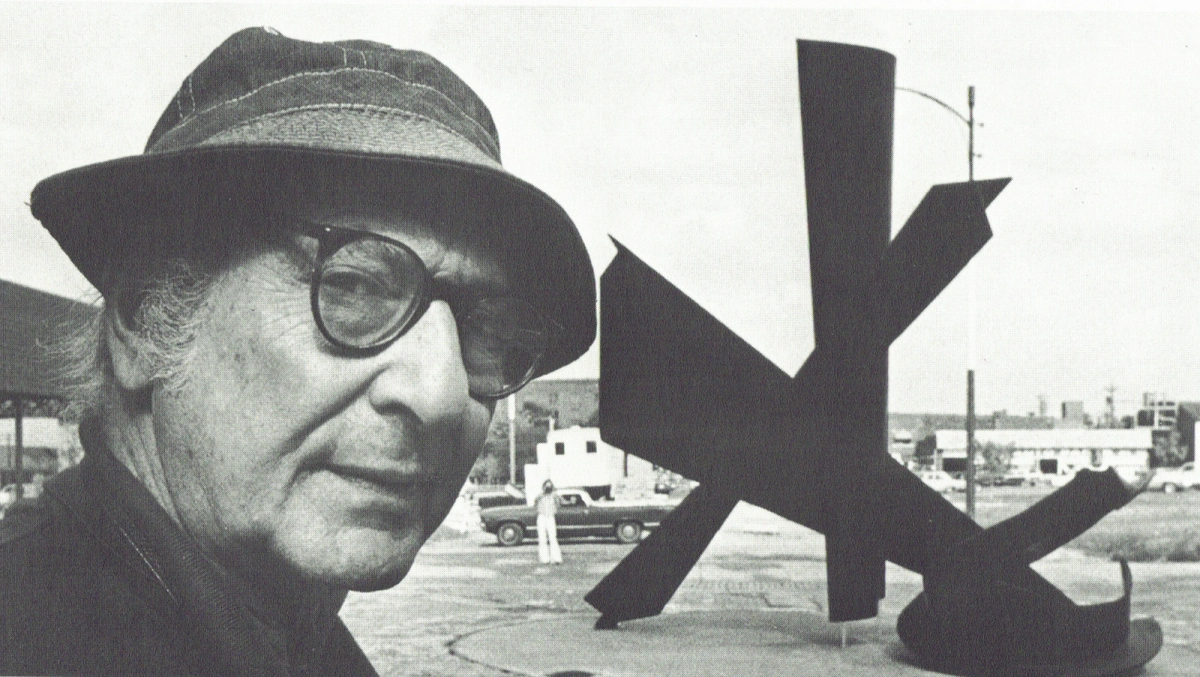
Lincoln Glenn Gallery announces representation of Herbert Ferber (1906–1991). In Summer 2027, Lincoln Glenn will present an exhibition of his sculptures, paintings, and drawings in conversation with sculptor Joel Perlman (b. 1943).
Herbert Ferber was a key figure in the development of Abstract Expressionist sculpture. He initially studied science and humanities at the City College of New York and Columbia University, earning a BS before going on to study dentistry. Throughout the 1930s, he practiced as a dentist and taught at Columbia’s dental school while simultaneously pursuing sculpture, studying at institutions such as the Beaux-Arts Institute of Design and the National Academy of Design.
By the early 1930s, Ferber had committed himself to sculpture, initially working in wood and stone and producing figurative works shaped by the social and political climate of the time. He exhibited with Midtown Galleries and became involved in artist organizations, including the American Artists’ Congress. In 1940 he joined a group of anti-Stalinist artists, including Ilya Bolotowsky, Adolph Gottlieb, Mark Rothko, Meyer Schapiro, David Smith, and Bradley Walker Tomlin in splintering off from the American Artists' Congress, a primarily Communist group, and founding the Federation of Modern Painters and Sculptors, signaling his alignment with more progressive artistic ideas.
By the 1950s, Ferber was recognized not only as a leading sculptor but also as an important theorist of modern sculpture. He was among the artists known as the “Irascibles,” who protested the conservative exhibition policies of the Metropolitan Museum of Art, and he was an active member of the Club, a forum for critical debate among avant-garde artists.
Ferber died in 1991 in Egremont, Massachusetts, leaving a legacy as a pioneer of direct metal sculpture and a major contributor to the expansion of sculpture into spatial and experiential realms.